










Budo Beat 59: The Shinpan Mindset, and Carrots?
The “Budo Beat” Blog features a collection of short reflections, musings, and anecdotes on a wide range of budo topics by Professor Alex Bennett, a seasoned budo scholar and practitioner. Dive into digestible and diverse discussions on all things budo—from the philosophy and history to the practice and culture that shape the martial Way.
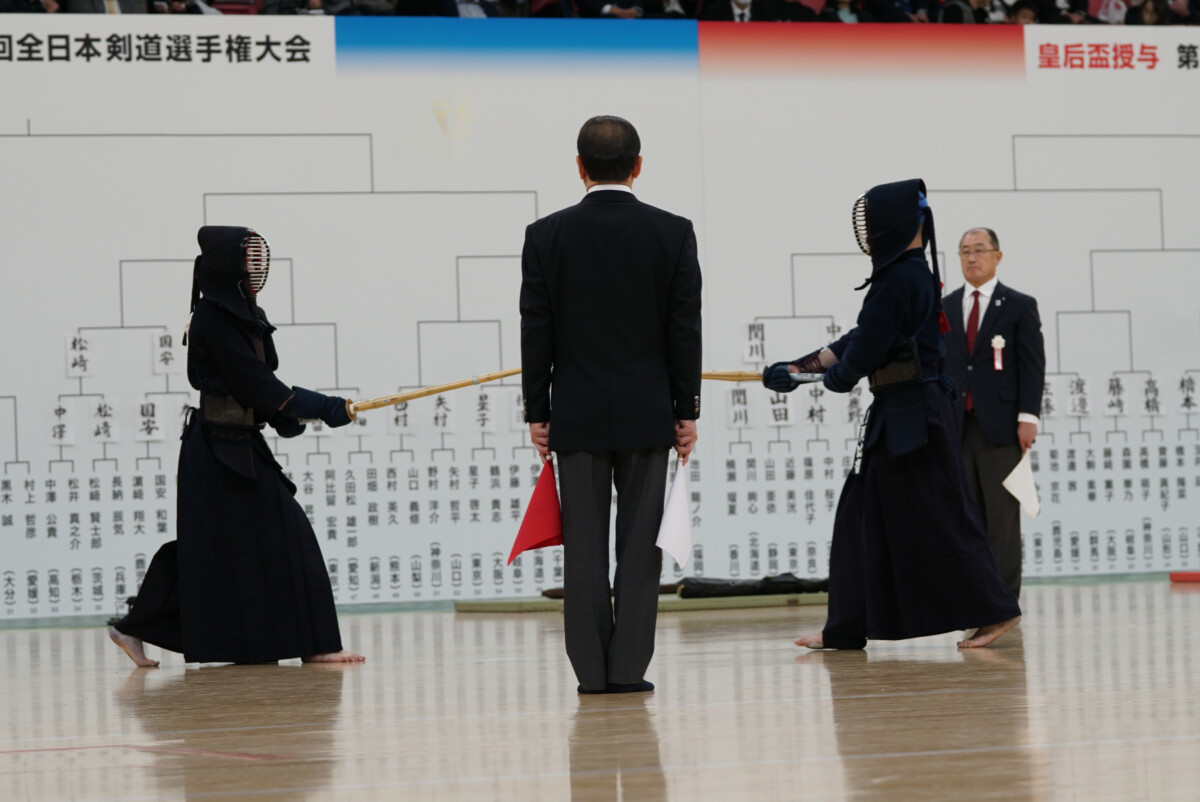
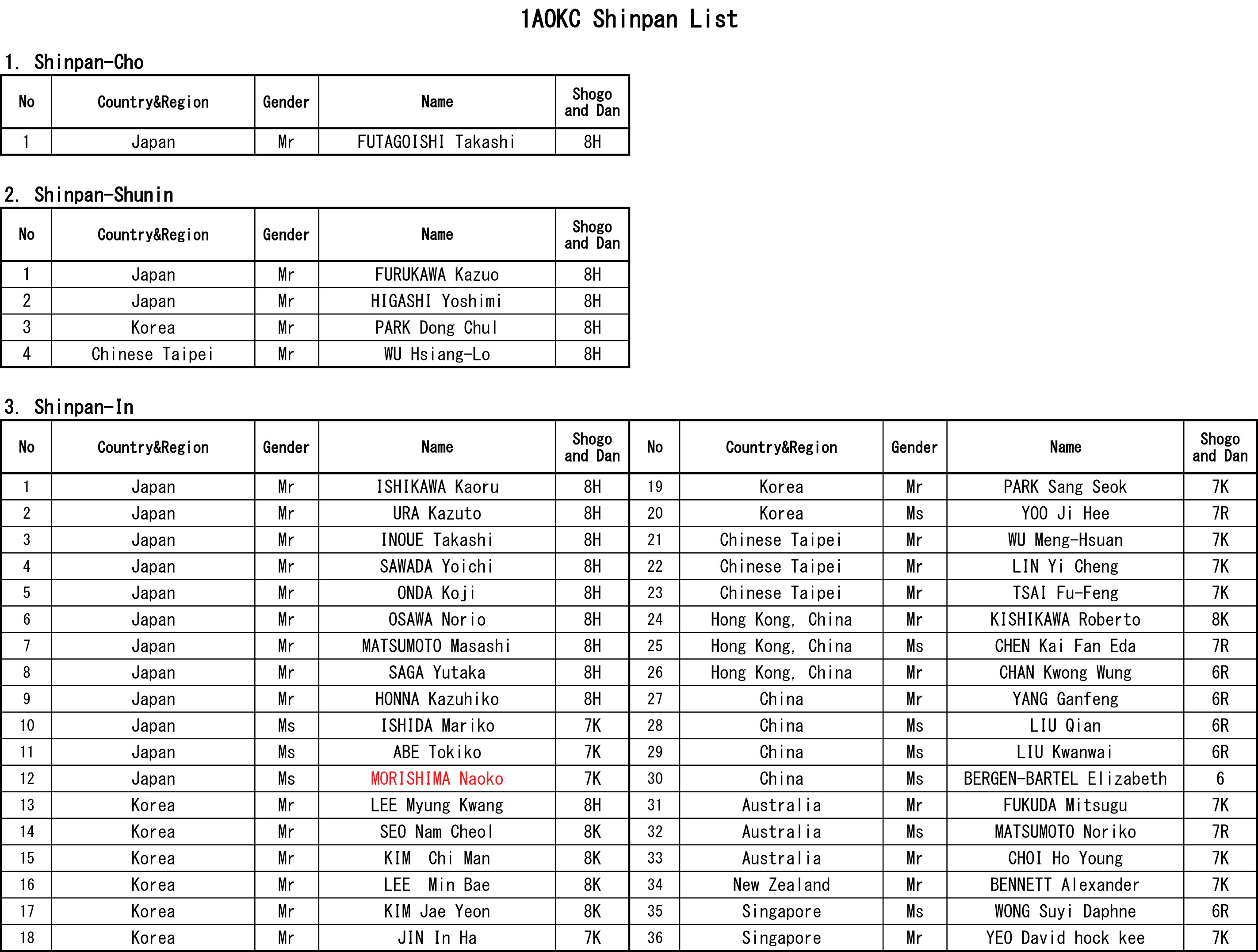
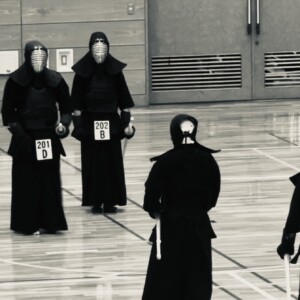
At the end of May, I will serve as a Shinpan (referee) at the 1st Asia Oceania Kendo Championships in Tokyo. I do feel quite honoured to have been selected. I’m also, truth be told, more nervous than I ever was as a competitor.
That might seem backwards. The competitors are the ones with everything on the line. They step onto the shiaijō (court) carrying years of effort in their bodies. They must perform under pressure while coaches give them the cold fishy eye, teammates laser-beam their backs with expectation, and family members and clubmates in the stands silently, and sometimes not so silently, rehearse their own version of the match. That’s precisely why I feel the responsibility so keenly. I know what a match means to competitors, and what it feels like to stand there with the heart thumping and no room left for self-doubt. I’ve been on both ends of the result, and I’m very aware of how long a dodgy decision can stay lodged in the mind afterwards.
As a competitor, you carry your own burden. As a Shinpan, you carry a little of everyone else’s as well. That’s simply the truth of the role.
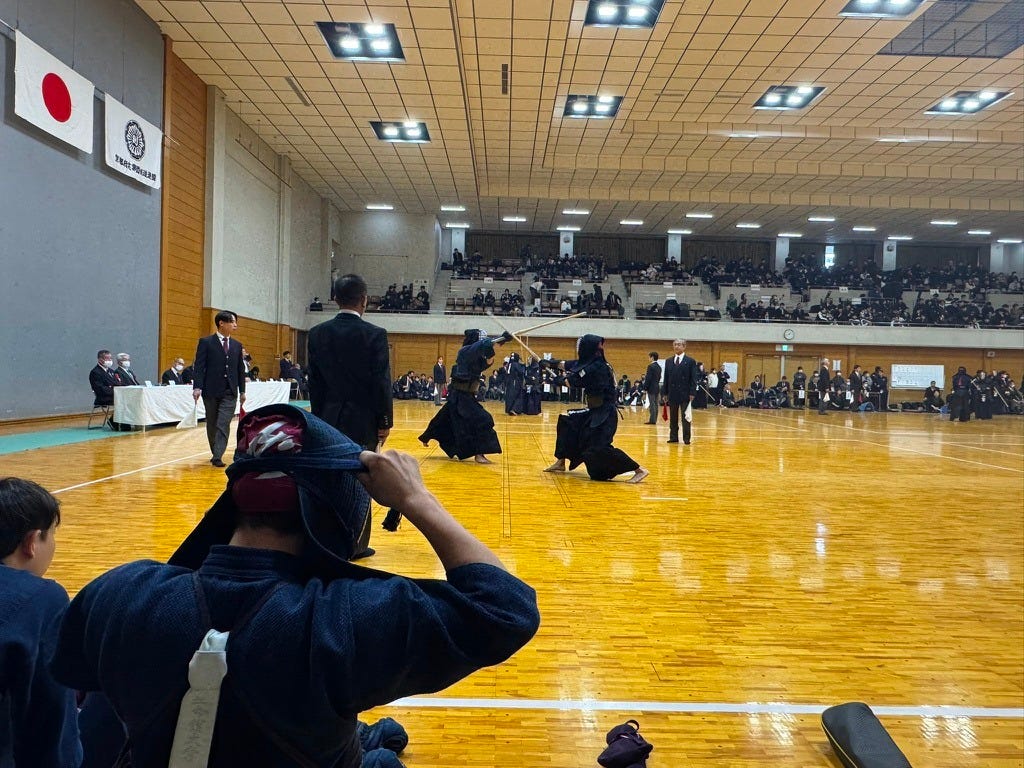
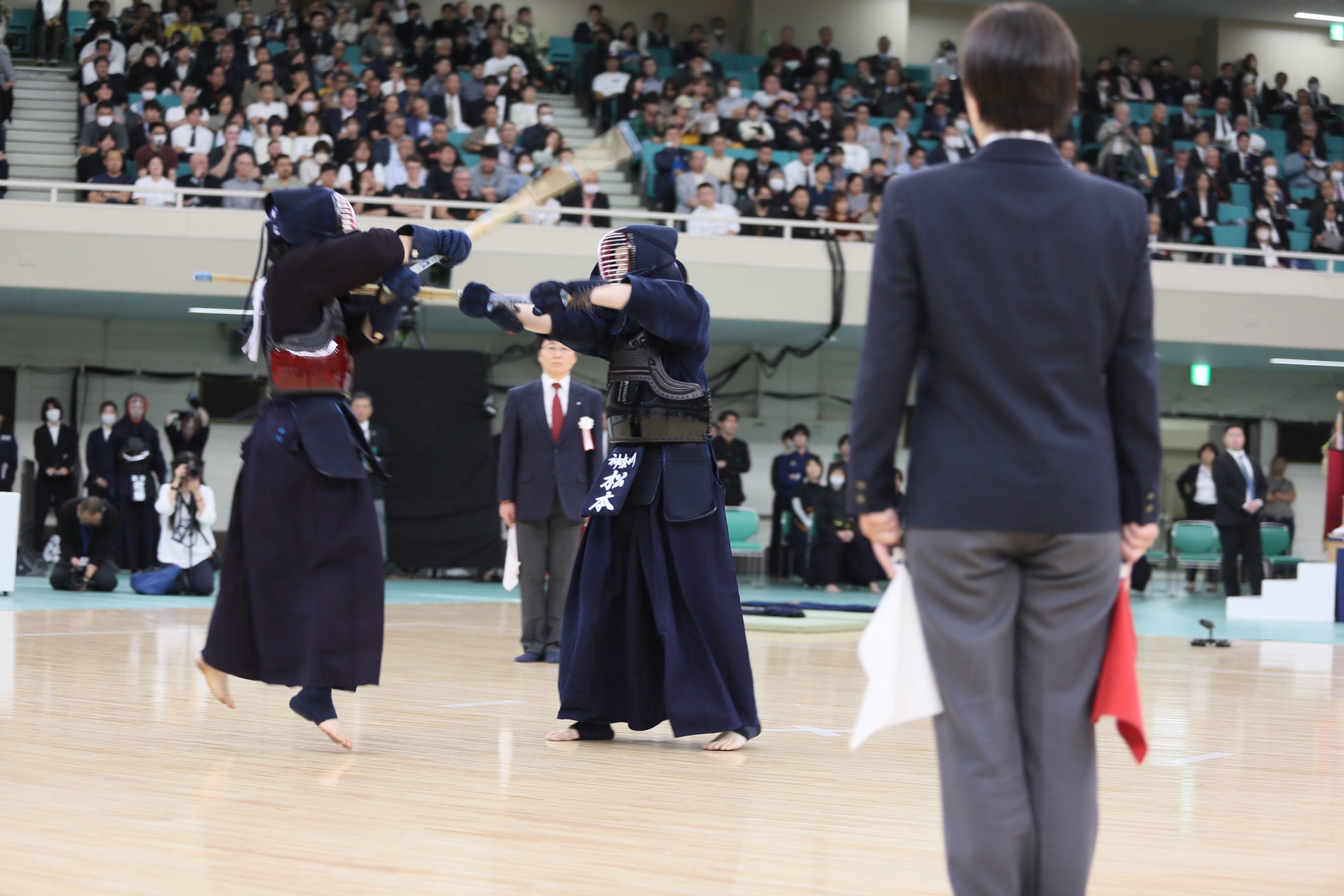
People watching kendo focus on the competitors, naturally enough. They are the visible drama. They supply the tension, the speed, the ambition, the technical brilliance, the victory or the collapse… The Shinpan, ideally, are not supposed to be dramatic at all. We are meant to be fair, clear, decisive, and a very smooth, confident unit. We are there to judge correctly and keep the match flowing. On paper, that sounds straightforward enough. In practice, it’s one of the more difficult things in kendo.
Because in kendo, unlike many sports, you are not merely deciding whether the ball crosses the line. You are judging the before, the during, and the after. Did the shinai hit the target? Fine. That’s only a part of it. Was the maai (distancing) right? Was the posture sound? Was there sufficient opportunity, proper intent, precise target area, enough force, correct hasuji (blade angle), and proper zanshin? Was the strike an expression of riai (reason) or merely a bit of random armour-smacking accompanied by energetic bodily appeals? Was it a true ippon, or just a persuasive imitation of one? All this in 0.3 seconds. And, don’t get me started on hansoku! Especially infractions from the close-quarter tsuba-zeriai position that are igniting so much debate these days.
Beneath all of this sits the traditional logic of the sword and the very concept of kendo. The meaning of ippon has evolved, of course. It did not descend from the heavens fully formed in the modern rulebook. But the basic assumptions still rest on sword principles. Hasuji matters because cutting matters. Posture matters because a collapsed body is not just unattractive but ineffective, and shows that ki-ken-tai-itchi (that all-important consolidation of spirit, sword and body) just ain’t there. Zanshin matters because intent and vigilance in the fray does/should not evaporate at the moment of contact. Kendo is not merely a game of flicking target areas on the armour. Or at least, it ought not to be. The Shinpan is standing directly in the path of that decline. Or at least, they ought to be.
In some sports, the decision is largely made for you. More and more, the heavy lifting of adjudication is left to technology. A light goes on, a buzzer bleeps, a replay is shown on a massive screen, and the officials are really just there to confirm it. Even then, they sometimes get it wrong! Kendo, however, remains gloriously, and sometimes infuriatingly, human. It still asks three individuals to judge in real time, under pressure, from a particular angle, with no machine to rescue them from doubt. That’s why Shinpan is not simply officiating. It is the real-time judgment of whether something was truly worthy of ippon. In other words, it’s not just ‘refereeing’. It’s deciding what counts as proper kendo.
And that means it does more than settle matches. It helps shape the future of kendo. If shitty strikes are acknowledged, competitors will adapt and take advantage of that. Human beings learn very quickly when bad habits bring rewards. If collapsed posture, hopeful flailing, shallow or imprecise contact, or opportunistic acrobatic nonsense is given as ippon, then more of it will follow. Before long, the contest itself deteriorates. When shiai deteriorates, kendo is pulled quietly in the wrong direction. That old teaching still holds: better Shinpan makes for better shiai, and better shiai makes for better kendo.

I’m committed to keeping my work freely accessible to all budo enthusiasts, wherever they are. If you’ve enjoyed what you’ve found here and would like to support my ongoing efforts and projects, “buying me a coffee” (beer actually), or my books, would make a world of difference. You can also support the construction of my dojo in Kyoto in the Shop Tab. Cheers!
So, the Shinpan is not merely there to apply regulations. They are kind of gatekeepers, there to uphold standards. It begins with fairness. A Shinpan must be impartial. No soft spot for one’s own dojo, no private affection for a student, no patriotic flutter for one’s own country, and certainly no sentimental obligation to the fellow whose teacher once shouted you a beer after a seminar. Reputation must count for nothing, crowd noise for zilch, and personal sympathy for absolutely bugger all.
Fairness is essential, but not enough. I heard the following gem at a local Shinpan seminar recently:
Fairness without decisiveness is chaos.
Decisiveness without fairness is tyranny.
This was not presented as a catchy slogan (although it is kind of cool), but as a habit of mind. A good Shinpan must stay calm without becoming passive, decisive without becoming theatrical, and confident without becoming self-important. Put more simply: see clearly, judge honestly, and act without fuss or hesitation. They must not be swayed by the competitors’ reputations or by crowd reaction. Nor should they follow the other Shinpan blindly.
That is why active keiko (training) remains indispensable. Rules matter, of course. One must know them thoroughly. A Shinpan who doesn’t know the rules inside out has no business standing there. But regulations alone do not create judgment. Keiko does. It’s through keiko that one develops a feel for seme, timing, pressure, rhythm, and the difference between a strike that is alive and one that is dead before it lands. You see the story before it unfolds. Keiko gives the Shinpan a body-based understanding of what yūkō-datotsu (valid strike) is supposed to be. Without that, you are nothing more that a half-arsed curator of regulations rather than a judge of living kendo.
One of the most sobering pieces of Shinpan guidance we got was this: “never turn the winner into the loser.” That’s the real fear. Marginal calls will always exist. Some moments are half-seen from one angle and clearer from another. Shinpan are human, not hovering surveillance devices. The grave error is not imperfection, but carelessness so serious that the rightful result is reversed. That’s what should trouble a conscientious Shinpan. It should keep a little edge of nervousness alive.
The world is not especially forgiving towards Shinpan now. A contentious call will end up on YouTube within hours and remain there forever, replayed in slow motion, pulled apart frame by frame, and judged over and over by people who were not standing there. Some criticism is fair enough. Some of it is bias, trolling, or the usual cheap certainty people discover when they are comfortably nowhere near the shiaijō. My first reaction in the comments section is often, “then you bloody well get out there and do it.” The fact is, mistakes will be made. That’s true in Shinpan, just as it is in life. There’s an ideal of perfection, but the reality is imperfection. That’s part of what makes Shinpan so difficult, and part of what makes it such important part of your budo shugyō. And, that’s part of why I feel more nervous now than I did when competing!
As a competitor, the pressure is intense, but contained. You train hard, step forward, do what you can, and live with the result. As a Shinpan, you are responsible for seeing properly in moments that matter deeply to someone else. A match may represent years of work, sacrifice, frustration, travel, injury, persistence, and hope… To judge that offhandedly would be inexcusable. In this context, a slight sense of discomfort is no bad thing. It means the weight of the role is still being felt, rather than relished as a form of decoration.
Related to this, humility is one of the most important qualities in Shinpan. That may sound odd, because Shinpan look formal, even a bit imposing. The uniform, the posture, the calls, the signalling, the movement all project authority and confidence. But the job is not to dominate the shiaijō. The best Shinpan are dependable rather than conspicuous. They do not drag attention towards themselves. They protect the integrity of the match. They step in when needed, fade back when not, and never confuse visibility with importance. The stars of the show should be, must be, the two shinai-wielding boffins.
So then, what is the mindset of a Shinpan?
It is technical, certainly. One must know the rules, understand the mechanics of judging, move well, signal clearly, and remain physically capable. It’s intellectual too. One must understand what one is seeing, not just stand there relying on aloof seniority. But beyond all that, it is ethical. A Shinpan has to keep bias, ego, and looseness out of the job, especially under pressure. That is why the role has always struck me as part of shugyō in its own right.
We often talk about kendo and budo as a path of human formation, and usually we mean what is learned through combat on the floor. Fair enough. But the same applies to those who stand in judgement over it. To exercise authority over others while disciplining one’s own mind is part of the training. To remain objective when emotion is thick in the air is part of it too. So is the ability to act clearly, honestly, and without self-display. Shinpan do not stand above kendo as neutral technicians, or outside it as mere administrators. They inhabit the same ethical world as the competitors. Their conduct, no less than the bout itself, is a form of budo practice.
That is what has become clearer to me over the years. When I was younger, Shinpan looked like a function of rank and experience, something one eventually did once enough time had passed and enough grades had accumulated. Now I see it differently. Rank may qualify a person formally, but it does not guarantee the inner habits the role demands. Those have to be cultivated and kept alive. A Shinpan must continue to train, to study, to reflect, and to improve. The moment they think they have nothing left to learn, they begin to decline.
As I prepare for Tokyo, that is the sort of thing I keep returning to. Certainly not the prestige of the appointment, if prestige is even the right word, but the responsibility to see properly, judge decisively, and protect the standard of the match. If the job is done well, Shinpan should leave very little trace of personality behind. People should remember the quality of the kendo, the ippon, and the spirit of the championship. They should not be talking about the referees. That, in the end, may be the finest outcome: to do the job properly and disappear into it.
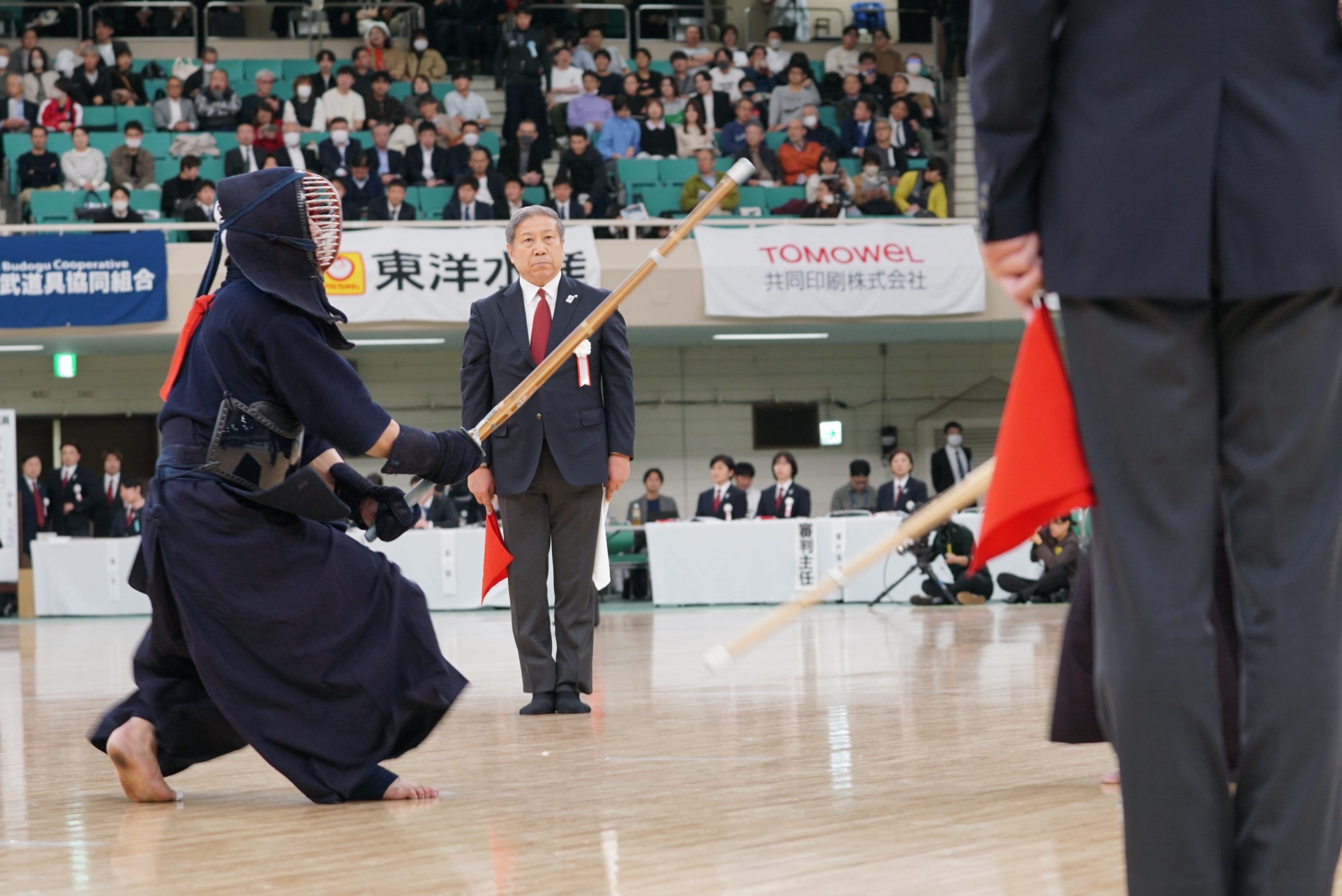
Mind you, disappearing into the job does not mean stiffening up like a man awaiting execution. A Hanshi sensei who shall remain nameless gave me another piece of advice, in terms that were impossible to misunderstand: “Relax, for crying out loud. You look like you’ve got a carrot shoved up your arse!” Crude, yes, but fair enough. There’s no point carrying yourself as though you are marching to the gallows. The work is serious, but that does not mean the face has to look as if the world is ending. If nobody notices you, and nobody is still grumbling about your calls over a beer afterwards, you have probably done the job reasonably well. That is the burden of Shinpan. It is also, in its own slightly thankless way, a privilege.





No comments yet.