








Budo Beat 57: Judge Dread – Examining the Examiner
The “Budo Beat” Blog features a collection of short reflections, musings, and anecdotes on a wide range of budo topics by Professor Alex Bennett, a seasoned budo scholar and practitioner. Dive into digestible and diverse discussions on all things budo—from the philosophy and history to the practice and culture that shape the martial Way.
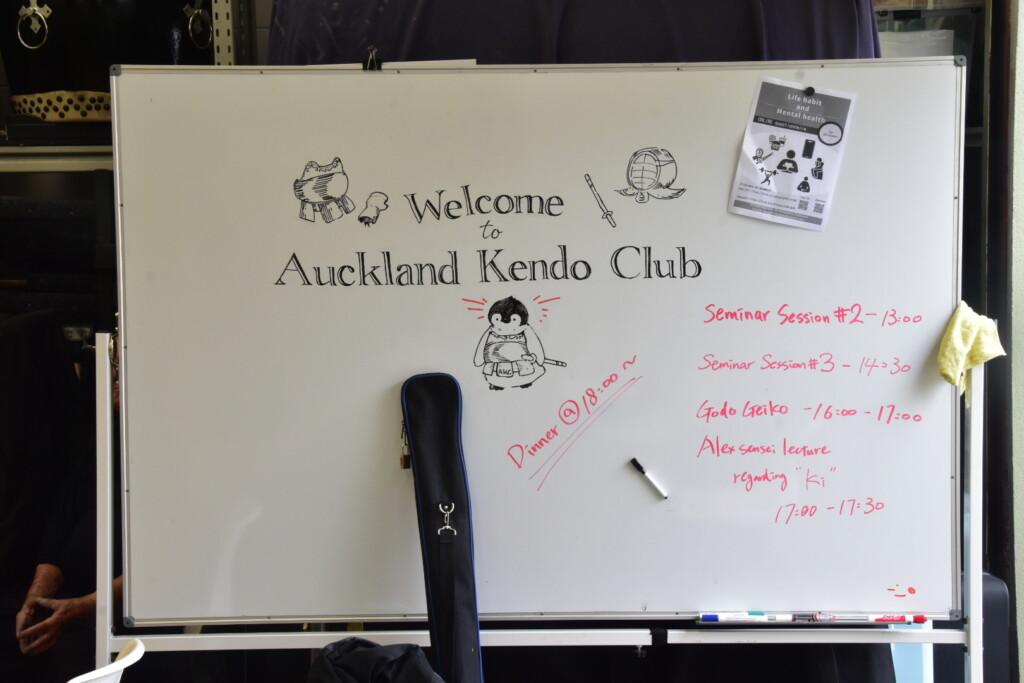
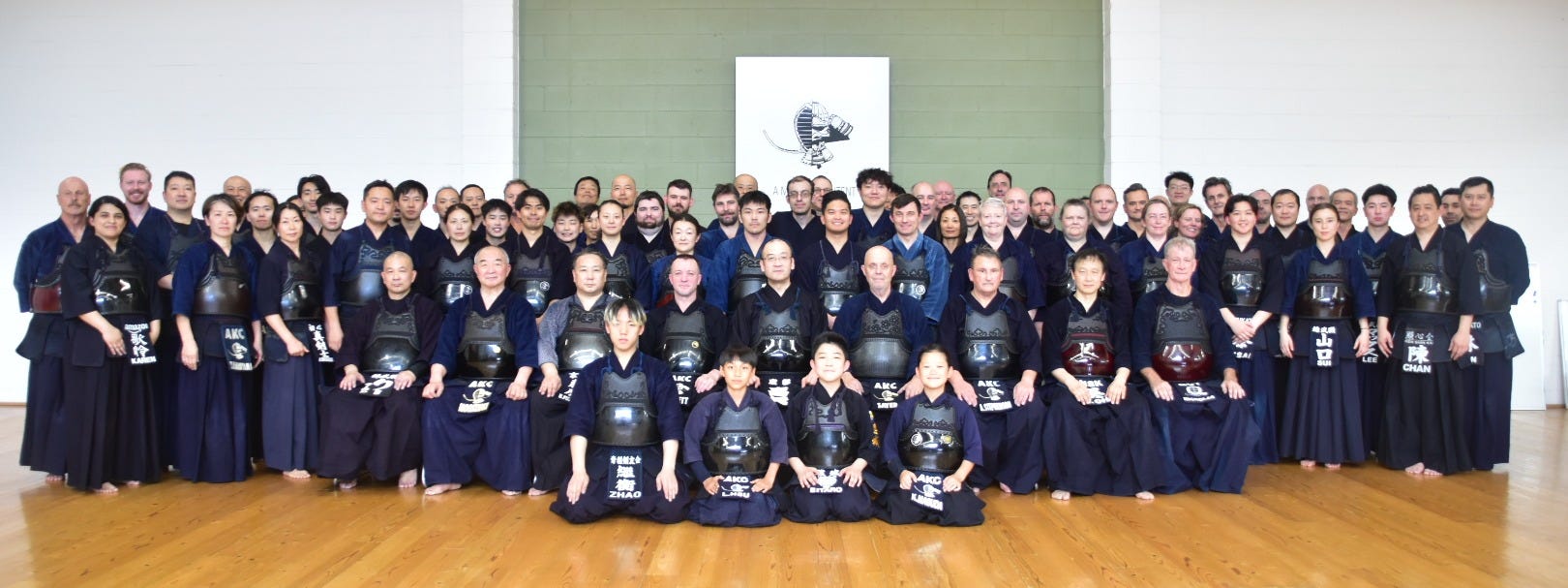
I’m on the plane flying back from New Zealand after attending the annual Auckland seminar which I’m kindly invited to lead each year. It’s a full-on few days. Copious amounts of keiko and a theme to frame it all. This year it was all about ki. As always, we finished with a Dan grading up to 5th Dan, and as is usually the case in NZ, I sat on the panel.
Being an examiner is the part I enjoy least. Well, I don’t enjoy it at all if I’m being honest. By that stage we’ve trained together all weekend and forged a special bond through our frenetic mishmashing of shinai. Many of the participants I’ve already known for years. Then suddenly I’m expected to become neutral and clinical with my cold fishy eye while they strut their stuff in front of me and the other examiners.
It’s a very awkward shift to say the least. One minute you’re mates sharing keiko, the next you’re Judge Dredd, or should I say “Dread”, deciding whether or not they are good enough to make the grade. Of course, deep down you want everybody to have a jolly sterling examination and pass whatever it is they’re attempting. Alas, the kendo gods are not always so agreeable.
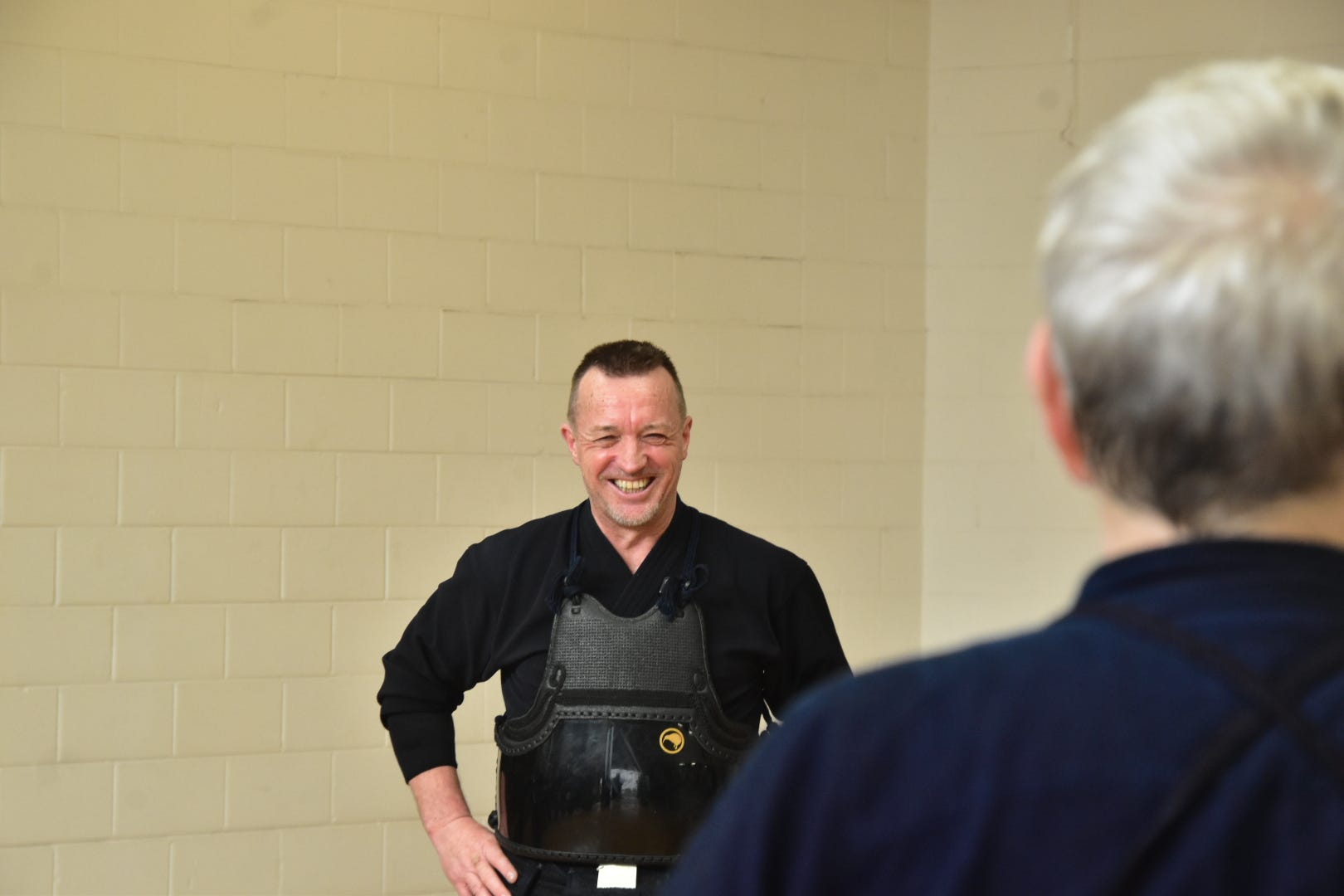
The role of examiner is a tough job with plenty of ramifications, but the strange thing is that nobody ever really teaches you how to be one. Stay in kendo long enough and climb high enough and you’ll be asked to sit on a grading panel. That is simply how it works. But I can’t recall ever being formally taught. Nobody ever said: right, this is what the role of a shinsa-in entails. This is your responsibility, this is what you prioritise for each Dan grade, and this is the shinsa-in mindset… It’s assumed that since you’ve survived your own examinations you somehow know what to do when it’s your turn to assess others. Apparently, the logic is that survival equals competence.
Dan examinations in kendo (and the other budo I study) compress a great deal into a very short space of time. Two candidates step in and have a couple of minutes on the floor. They do what they can in that fleeting moment, knowing that years of keiko are being distilled into two brief exchanges. From the outside it may look almost insignificant. From the inside it feels anything but. Boy, I know that pressure oh so well!
As an examiner you are not there to be entertained or dazzled. You are there to decide coolly whether what you saw meets the mark. And yet, the decision often crystallises in the instant something ‘dazzling’ cuts through the noise and makes you sit up for the right reasons. When a performance truly demands your attention like that, the panel usually becomes unanimous very quickly. There is very little question. Along with the target, hearts have been struck…
The difficulty lies in the grey areas. When two performances sit somewhere between convincing and not quite enough, the decision inevitably reflects the examiner’s values. Those values are not written anywhere. They are cultivated slowly through years of training, watching, failing, and being corrected. That is why examiners sometimes see things differently when a performance sits on that boundary. But when someone genuinely makes you sit up and watch, those differences tend to disappear.
Dan ranks are not meant to signify perfection, but a certain depth of understanding and technical ability commensurate with the rank. From 4th Dan upwards especially, speed and dexterity should no longer be the headline act. Nor are you really there to check how well they know the basics. At this level, technical proficiency in the fundamentals ought to be a given. What you are really searching for are signs of command. A certain presence. The stirrings of seme that disturb the opponent’s balance before a strike is even executed. A kamae that looks settled and beautiful. And waza that grows naturally out of pressure, not out of panic. When the cut comes, it should feel inevitable rather than hopeful. That is, striking the right targets at precisely the right time, in the right frame of mind.

I’m committed to keeping my work freely accessible to all budo enthusiasts, wherever they are. If you’ve enjoyed what you’ve found here and would like to support my ongoing efforts and projects, “buying me a coffee” (beer actually), or my books, would make a world of difference. You can also support the construction of my dojo in Kyoto in the Shop Tab. Cheers!
You can’t factor in who has been trying unsuccessfully for years to pass the exam, those who travelled the furthest, or who trained hardest over the weekend. Neither should you pass someone just because it would be immensely encouraging to them or their club. Nor, of course, should you fail someone to make a point, or because you don’t particularly like the candidate! What happens in front of you in those minutes and seconds, in principle, is all that counts.
Maintaining that discipline when you know the people involved, however, is far from easy. And if we are honest, 100% complete objectivity is probably a myth. We like to imagine that we sit there as perfectly neutral arbiters. But we are human beings. What if one of the candidates is fighting stage 4 cancer and this might realistically be their last attempt? What if someone has rebuilt themselves after a serious accident just to stand there again? Once you know those stories, you cannot simply switch them off.
These are not theoretical dilemmas for me. I have grappled with all of them in real examinations, this one included.
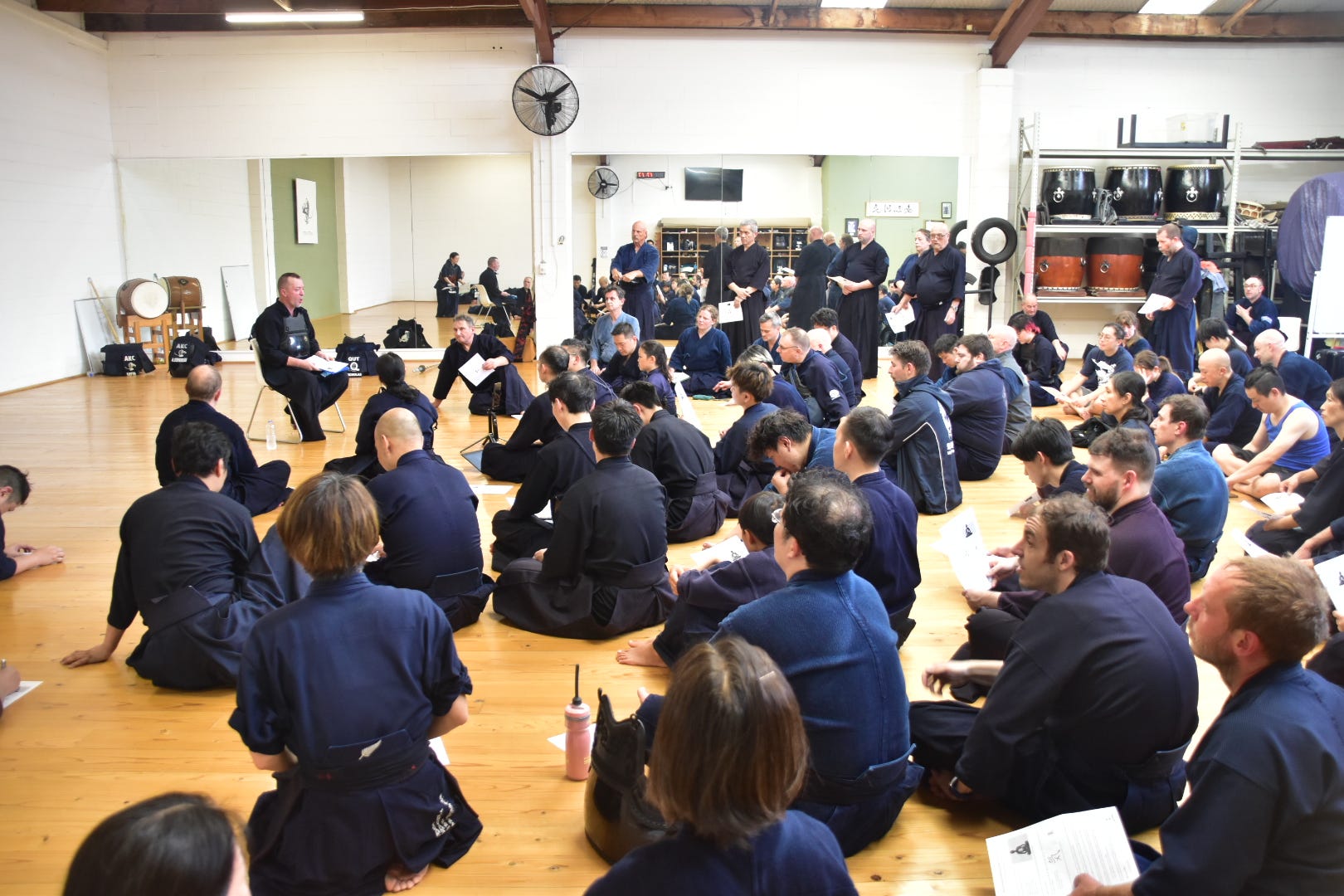
The question then becomes uncomfortable. Are you really judging the kendo in front of you, or the life story behind it? Strictly speaking, it must be the former. The grade is not awarded for courage in adversity. And yet, pretending you are untouched by those realities would be a lie. Part of the maturity required of an examiner, therefore, is recognising your own pull towards empathy, acknowledging it quietly, and still returning your gaze to what is actually being expressed between the shinai.
As I’m fond of saying, context matters. In a small kendo country like New Zealand, anonymity is a polite fiction. You know just about everyone on the floor. You know their families, the knee that went years ago, the shoulder that still complains in cold weather, and the small fortune in time and airfare it took for them to stand there in front of you. All of which makes the examiner’s task rather more delicate than the theory suggests.
In addition to this, there are many other not insignificant complications faced in smaller kendo populations. For example, the age range within a single grade can be vast. It would not be unusual to see a 59-year-old facing a 29-year-old in a 4th or 5th Dan examination. On the surface the younger candidate will almost always look sharper. Faster footwork, crisper strikes, and more obvious athleticism. It is very easy to be drawn to that and equate speed with quality.
But that is precisely where an examiner has to be careful. The older candidate may not move as quickly, but the build-up might be subtler. Superior even. The pressure more sustained. Their ki more settled even though their movement is a tad clunky and slow. Much of their skill is not obvious to the naked eye and difficult to perceive unless you are carefully watching the process rather than the final strike. In those moments with two conflicting styles that are both valid you have to remind yourself what level of understanding the grade is actually meant to represent.
In Japan this is not really an issue. The sheer number of candidates makes it easier to group people into more appropriate age brackets. You are far less likely to see such stark generational contrasts within the same pool. In New Zealand, we simply do not have that luxury.
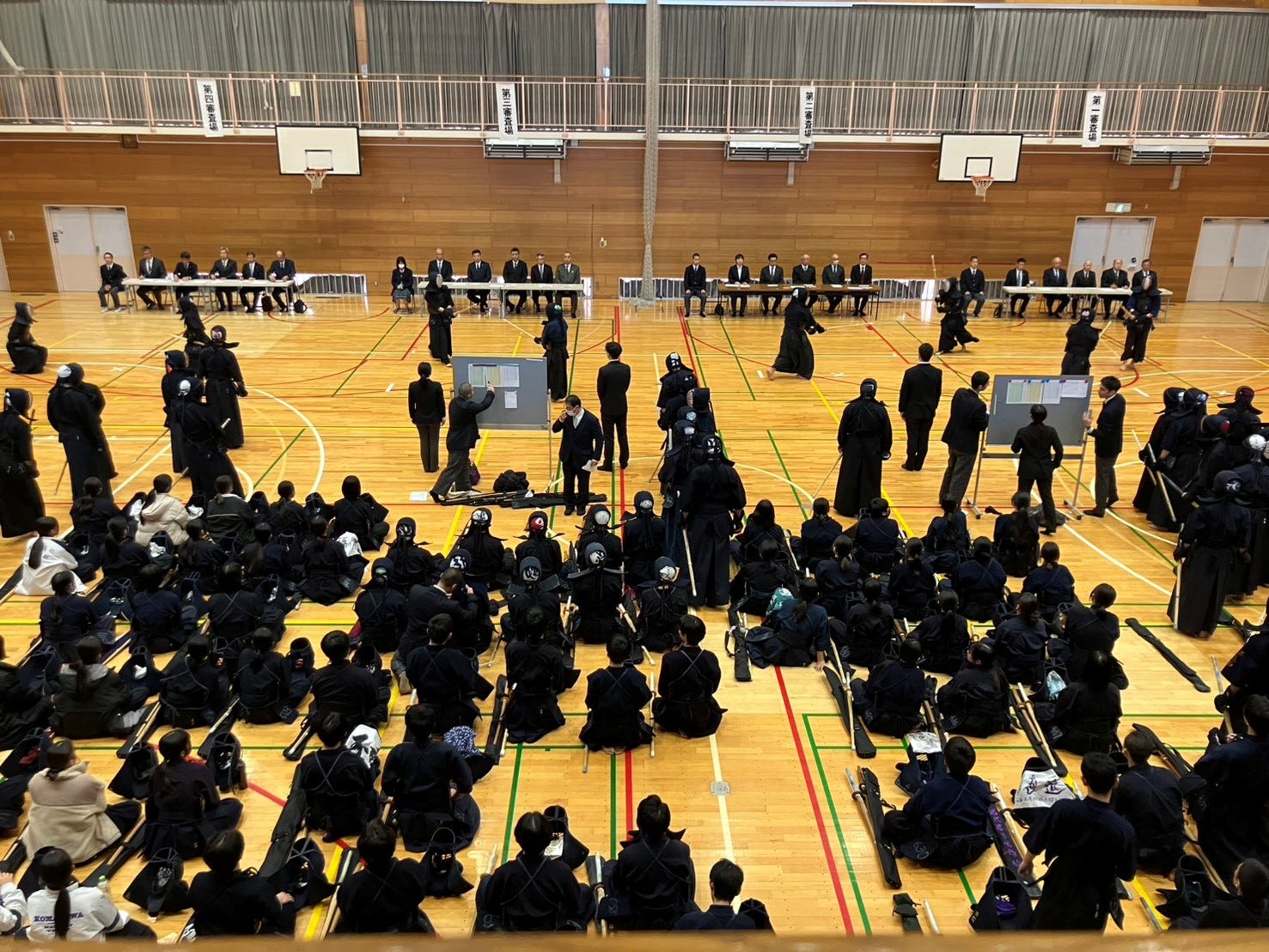
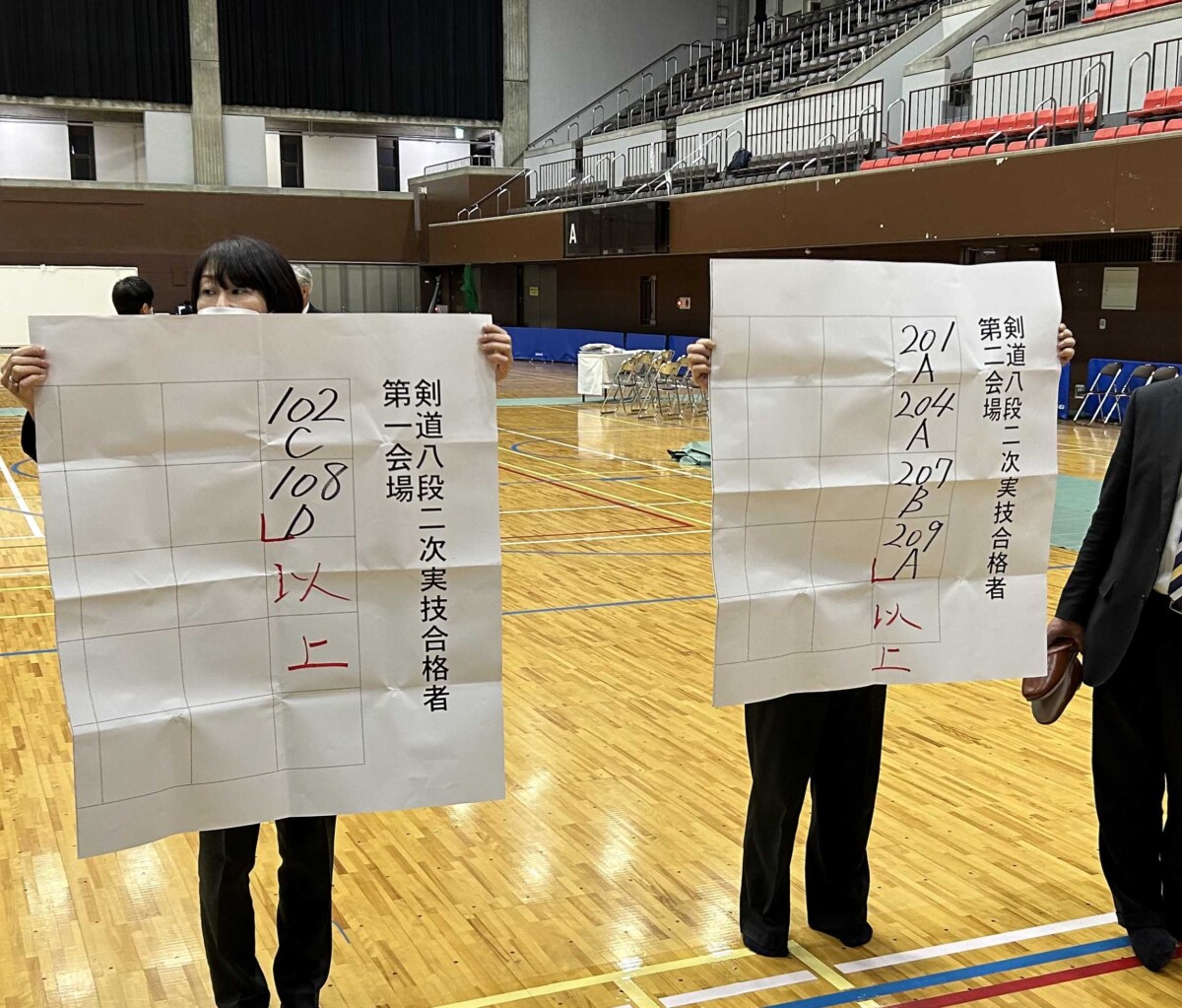
The scale in Japan alters the entire dynamic. When I have taken examinations there as a candidate, it has felt almost industrial. Rows of us line up stretching what seems like forever. We step forward in groups, bow, fight for what feels like a blink, bow again, and disappear through a side door. In that moment you are not a name. You are a number on a sheet.
Later, another sheet goes up on the wall with more numbers. You stand there in the crowd, scanning for yours. Shoulders drop around you, and some people walk away despondently, trying not to show any emotion. Their number wasn’t there.
It’s efficient. Clinical actually. The scale creates distance. As a candidate, you feel anonymous, exposed for a moment, then absorbed back into the system. And I guess the examiners do, too. There is no chance of going up to an examiner later and asking why you failed. And the examiner doesn’t need to strain their memory trying to think of something useful, or even encouraging, to say. The day is done and dusted, and the presence or absence of your number on that big sheet of paper is the only feedback you are going to get. Unless, that is, you are lucky enough to have had somebody take a video of your performance for future nit picking.
Kendo at least likes to stress that this anonymity exists everywhere. Unlike some other budo, candidates must remove their nafuda name patches before stepping onto the floor for grading. Faces are hidden behind the men. In theory the examiner does not know who is who. It is all very egalitarian, at least on paper, and wonderfully pure.
In New Zealand, however, this noble fiction lasts about three seconds. You can recognise people easily by their kamae, posture, kiai, and by the way their men is tied on. When you have trained together for years, the silhouette alone gives the game away. So much for anonymity. We keep the ritual, of course, because the ritual matters. But nobody on the panel is under any real illusion about who is standing in front of them.
In Japan, scale provides a kind of buffer. In smaller communities like ours, there is no such insulation. As an examiner in a small kendo scene like NZ, you carry more than just the two-or-so minutes in front of you. You carry history, context, and relationships which is both a privilege and a burden.
Candidates are usually tight with nerves and are almost looking at you for comfort, some non-verbal cue that they’re going to be okay. The panel has a responsibility not to succumb to that, or conversely, add to the tension. Sitting properly, paying attention, and keeping your own reactions contained matter more than people realise. An examiner who frowns, whispers, or shifts about constantly may well unsettle the room. But it’s so hard not to when you know the candidates.
I should add that there are positives to serving as an examiner. It is excellent study. When someone’s performance makes you sit up, you have to ask yourself why. What was it exactly? The timing? The seme process? A perfectly crisp cut that forces an involuntary, barely suppressed Ferris Bueller-esque “oh yeah” that you hope nobody heard? Or was it something less tangible, a sense of composure under considerable pressure? You are forced to analyse your own reactions. Why did that strike feel special? Why did that exchange feel shallow even though it was technically clean? And so on.
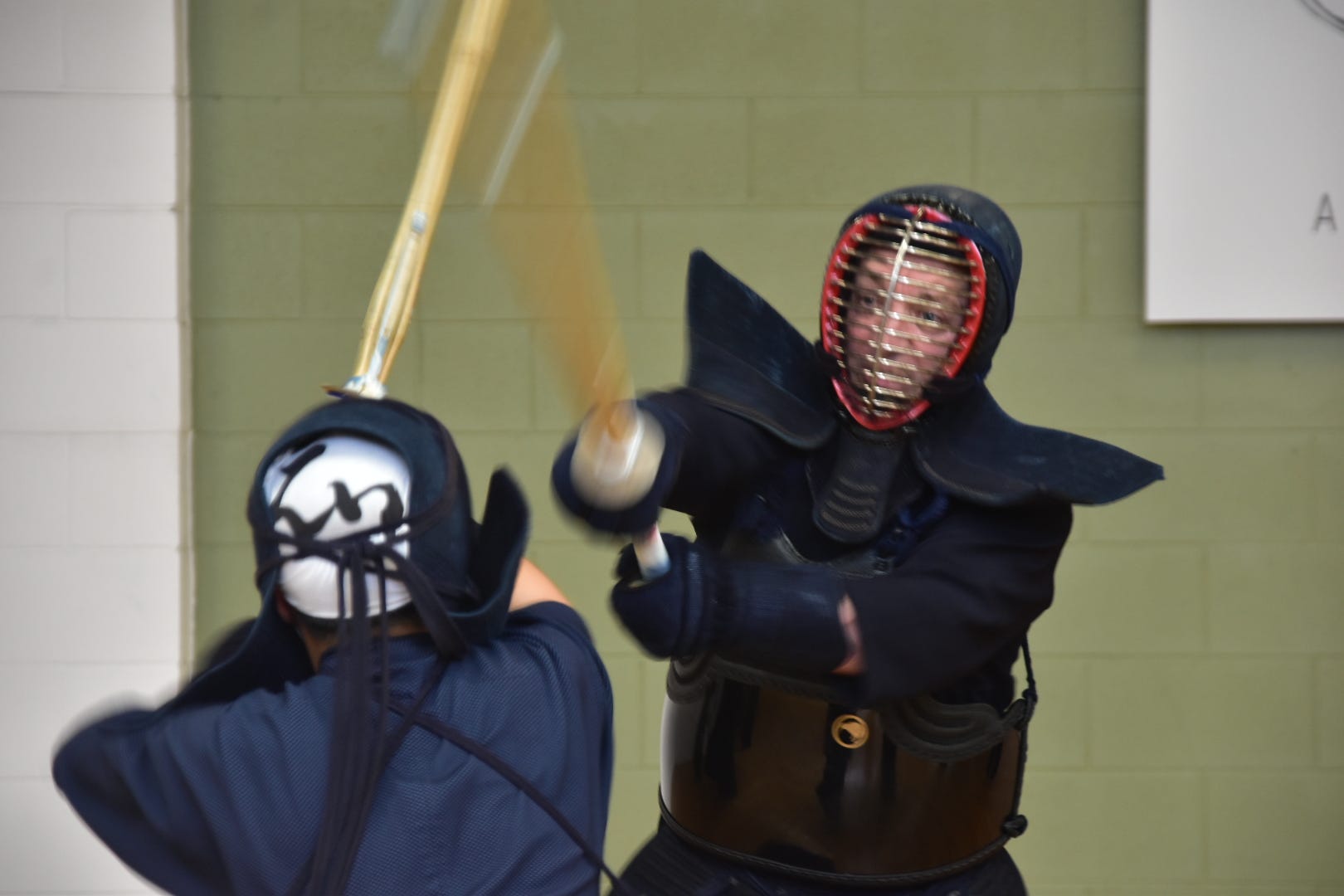
In that sense, sitting on a panel offers clues for your own keiko. The qualities that stand out, quietly but unmistakably, are the same qualities you need to cultivate when it’s your turn to bow in. Watching others under examination light can be uncomfortable for the reasons stated above, but it certainly sharpens your eye. And that eye inevitably turns back on yourself.
Every time I sit on a panel I’m acutely aware that the standards I apply to others apply equally to me. If I expect composure, depth, and presence from a 5th Dan candidate, I have no business demanding less of myself. Serving as an examiner is a reminder that rank is not something you achieved once. It is something you must continue to justify and improve on.
Failing someone is never pleasant. You know what it means to them, and it hurts. But passing someone before they’re ready does them no favours either. It only creates a gap between the certificate on their wall and the kendo they can actually produce. That gap is uncomfortable for everyone, and they will hit an even bigger wall in the future.
In the end, sitting on a panel should strip away any illusion of authority and replace it with responsibility. The standards you apply are not really yours to invent or bend. You are simply holding a line, albeit it a fuzzy one, that was drawn long before you arrived, by the teachers who came before you, and one that will remain long after you step away from the table. For a brief moment you are just one of the custodians of that line, expected to protect it as honestly as you can with your own accumulated knowledge and values. Which, when you think about it, makes it all the more curious that we are almost never actually taught what this job entails, whereas becoming a shinpan (referee) usually comes with far clearer instruction. Nobody teaches you how to be a shinsa-in. You simply become one and hope that decades of watching others have seeped into your bones.
And that is why the awkward parts, especially in the aftermath, matter. Meeting the gaze of those who failed. Sometimes speaking with them afterwards when they come up almost teary, asking for advice. All the while, just a few metres away, others are celebrating the euphoric relief of having passed, hugging jubilant supporters and other sweaty successful candidates, taking photos in front of that big sheet of paper with their numbers on it. The contrast makes the moment even more uncomfortable. What they are really asking, of course, is not about footwork or seme. What they are really saying is: why am I not good enough? Where the hell am I going wrong? In truth, very little you say in that moment is likely to sink in anyway.
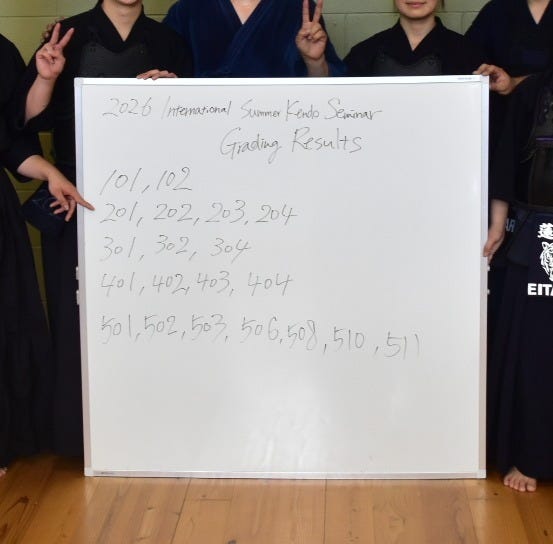
The quiet weight that lingers afterwards, and the second‑guessing of your decisions on the drive home are not inconveniences as much as they are all a part of the job. Being a shinsa‑in is not a reward for reaching a certain rank, although I have encountered a few who seem to revel in the power trip it gives them. Such people do not realise that being an examiner is another mirror held up to your own kendo. It is another stage of training. If you are paying attention, it humbles you more than it elevates you. It becomes another stage of training. An opportunity to question your own values and understanding of kendo. A kind of keiko where, ultimately, you are also being tested.









No comments yet.