











Budo Beat 58: Zen, Budo, and the Keisaku Queue
The “Budo Beat” Blog features a collection of short reflections, musings, and anecdotes on a wide range of budo topics by Professor Alex Bennett, a seasoned budo scholar and practitioner. Dive into digestible and diverse discussions on all things budo—from the philosophy and history to the practice and culture that shape the martial Way.
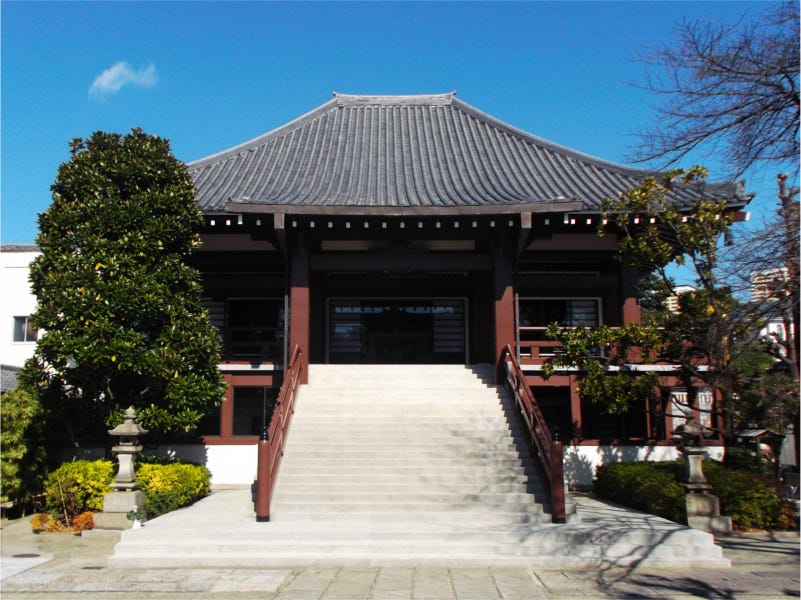
Last week I found myself in that familiar precarious position of standing between two worlds, trying to make sense of one for the other. This means first somehow making sense of it myself! On this occasion, it was at the 8th International Budo Seminar, where I had the job of translating a lecture delivered by the head priest of Zenshōan, Hirai-sensei, on the topic of “Zen and Budo”.
Now, whenever those two words appear together, a certain kind of expectation seems to hang in the air. Zen equals spiritual calm. Budo equals discipline. But the two of them go together like hand in glove. It’s like that old teaching “sei-chū-dō, dō-chū-sei” (stillness within movement, movement within stillness).
Just like the old poem attributed to Miyamoto Musashi:[1]
Behold it well—
the racing horses at Kamo, matched stride for stride;
even in their charging and turning, there is Zazen.
From the age of thirteen he engaged in real duels, passing through more than sixty life-and-death encounters beneath the blade. Through this, his sword had already achieved the unity of sword and Zen without ever formally studying Zen.
Even though he did turn to Zen in his later years, this was merely to reflect upon and articulate what he had already realised through the sword.
Hirai-sensei didn’t mention Musashi, but he talked at length on Yamaoka Tesshū, a known Musashi aficionado, and founder of the Zenshōan. The priest began by addressing something that most of us in the room probably felt. “Zen is one of those words that has travelled the world and lost a good deal of its luggage along the way. It is now ‘ZEN’, capitalised, exported, and somewhat commodified.” Hmmm. He’s right. You find it attached to everything from meditation apps to interior design, which is usually a warning sign. But ask seven people what Zen actually is, and you will get eight answers. (See what I did there?)
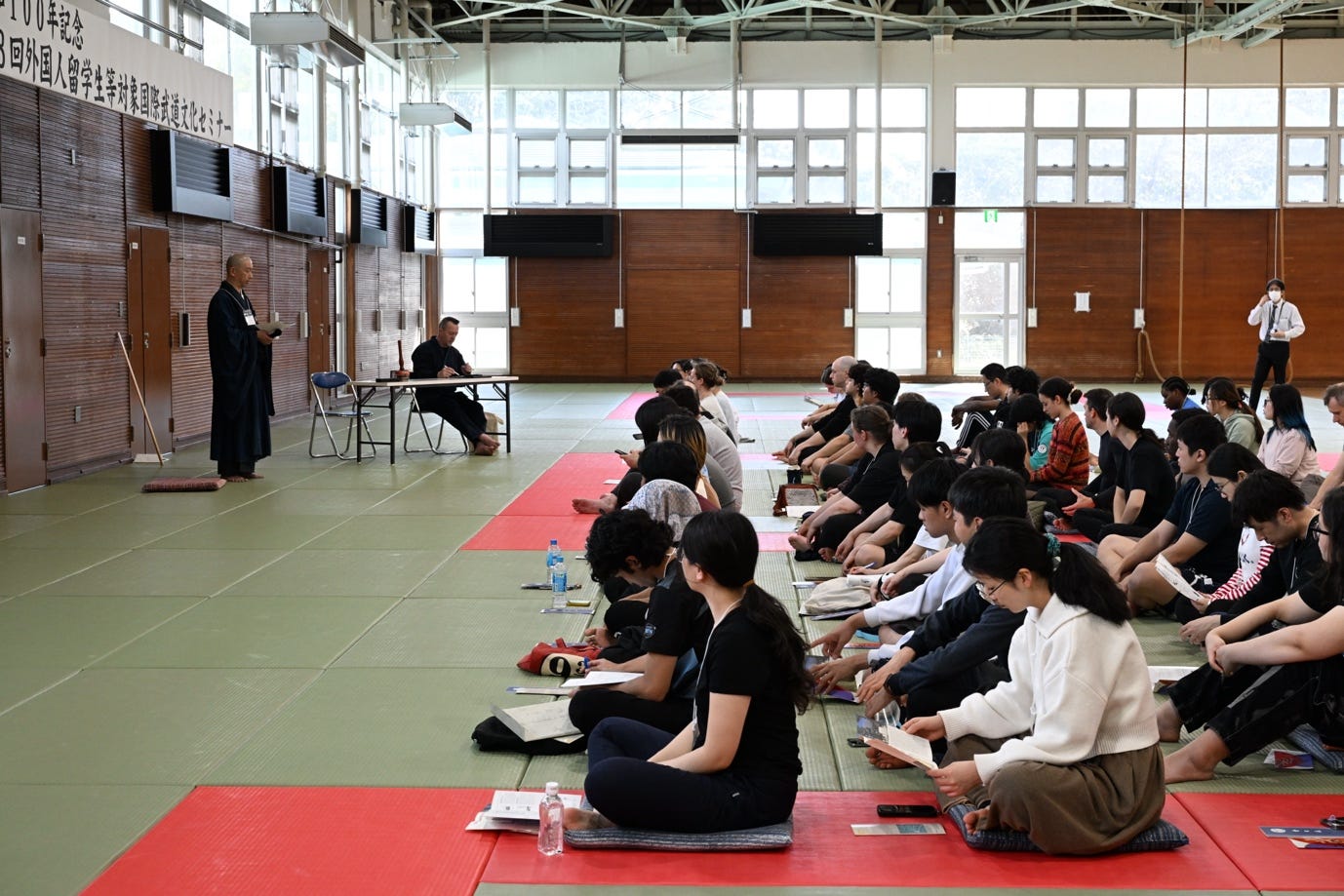
At its core, he reminded us, Zen is simply a branch of Buddhism. It began in India, travelled through China, and eventually took root in Japan, where it intertwined itself with the local climate, aesthetics, and temperament. Over time, it seeped into almost every corner of traditional Japanese culture. Noh theatre, ink painting, garden design, tea ceremony, flower arrangement. And yes, the martial arts.
But here is the first important point he made, and one that tends to disappoint those looking for something more exotic: funnily enough, Zen is not about acquiring special Yoda-like powers. There is no hidden technique that will suddenly make you invincible, enlightened, or particularly impressive at dinner parties. In fact, it runs the other way.
Zen, he explained, is, at its most basic, “the practice of sitting quietly and attempting to calm the mind. That’s all.” And that “all” is where most people tend to come undone because what you are actually doing is stripping away everything that has accumulated in your mind over the years. “All the likes and dislikes. The petty jealousies. The attachments to status, money, recognition. The endless commentary that runs through your head from morning to night.”
He gave a simple example. “If someone you like criticises you, and someone you dislike says exactly the same thing, can you receive those same words in exactly the same way?” If you can, he said, “then you have already grasped the essence of Zen.”
Another example. “When you lose something you once possessed, even if you know intellectually that it was never truly yours to begin with, can you let it go without resistance?” Again, easier said than done.
“The process of Zen training”, he continued, “is like peeling away layers of thin paper, one sheet at a time, with no clear sense of when you will reach the end. It is slow, repetitive, and often frustrating. But gradually, something begins to emerge. Not something new, but something that was there all along! Your original, unadorned mind.”
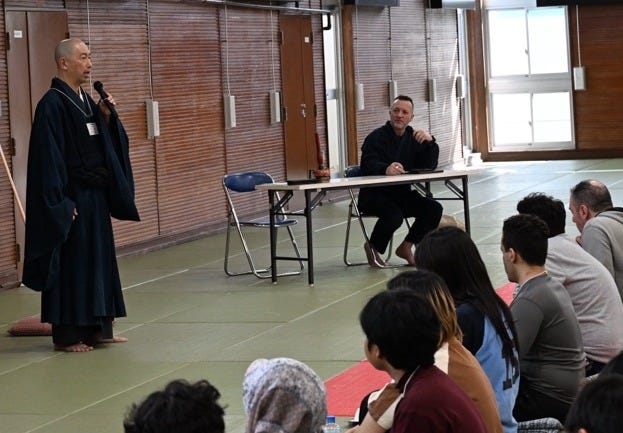
So, that is Zen. Not becoming or gaining something. But, returning to what you already are, once all the unnecessary BS and clutter has been cleared away.
So where does budo fit into all of this? The relationship between Zen and budo is obvious enough once pointed out, but not always easy to see at first glance. Hirai-sensei used a rather elegant analogy. “If Japanese culture as a whole is like a tree, then Zen is the root system. You cannot see it from the outside, but it supports everything. Budo is one of the branches.”
Zen and budo are not the same thing. One is a religious and philosophical discipline, the other a set of martial practices with their own histories, techniques, and internal logics. But over time, the spirit of Zen has infused budo, in some ways shaping its aims and its language. You see this most clearly in the ubiquitous use of the word dō, the “Way.” Kendō, jūdō, chadō (tea), kadō (flower arranging), shodō (calligraphy). The Japanese seem to attach dō to anything that will sit still long enough, and quite a few things that won’t. I mean, even baseball was called yakyū-dō at one point in time.
But this is not mere linguistic decoration. The “Way” is meant to point to a process of cultivation, and at its heart lies the mind. There is an old saying, he informed us: “Zen is the name for the mind”. Whatever path you follow, the real work is always internal. To illustrate this, Hirai-sensei turned to Yamaoka Tesshū, one of those legendary historical figures who seem to have been pretty good at everything. A master swordsman, a calligrapher, a statesman, and a dedicated practitioner of Zen. His influence on the evolution of modern kendo and its philosophy cannot be overstated.
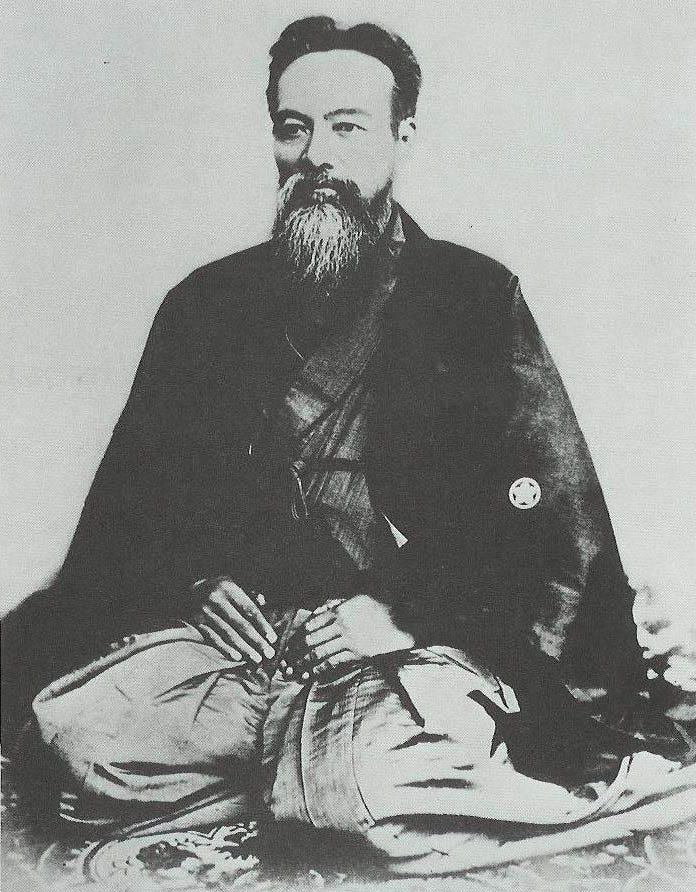
The well-known story goes that at the age of forty-five, Tesshū attained enlightenment through Zazen. At that exact moment, he also realised that he had reached the ultimate truth of swordsmanship. To him, the two were not separate achievements.
It sounds suspiciously neat. But Tesshū’s life gives the statement “Zen is the name for the mind” considerable weight. He lived through the collapse of the samurai class after the Meiji Restoration, a time when swordsmanship was rapidly becoming obsolete. Many of his contemporaries simply gave up. There was no longer any practical need to train in the traditional martial arts. After all, who brings a knife to a gunfight? Tesshū, however, kept going. In fact, he was absolutely relentless. Not because he expected to fight anyone, but because he understood that the true purpose of training lay elsewhere.
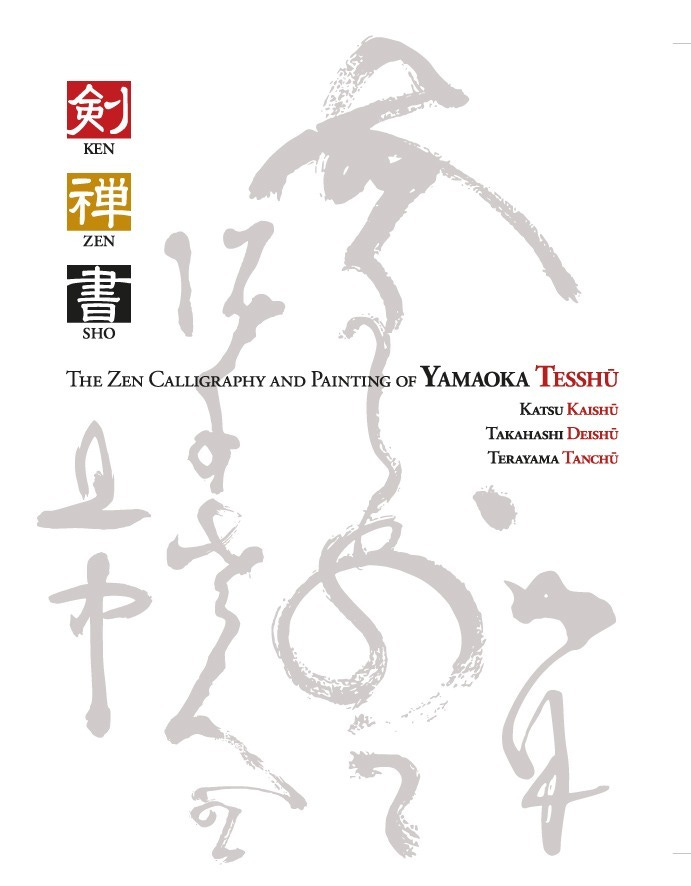
Before the Meiji period, ken-jutsu was spoken of as sword techniques for cutting people down. After Meiji, those techniques mostly lost their original murderous function. What remained was the possibility of transforming them into something else, and to this end, Tesshū left behind a line that the priest quoted: “The foundation of sword training is to polish the spirit, and to ensure that there is not the slightest opening when facing an opponent.”
Modern kendo was born from that shift. The sword was no longer for cutting others, but for cutting away one’s own weaknesses. The opponent remained, but the real struggle was internal. To be fair, this wasn’t entirely new. Edo-period martial arts already had one eye on this, but it was this spiritual aspect of swordsmanship that kept it alive and relevant into the next epoch of modernity. It guided the next stage of its evolution well into the 20th century.

I’m committed to keeping my work freely accessible to all budo enthusiasts, wherever they are. If you’ve enjoyed what you’ve found here and would like to support my ongoing efforts and projects, “buying me a coffee” (beer actually), or my books, would make a world of difference. You can also support the construction of my dojo in Kyoto in the Shop Tab. Cheers!
But what is the destination? Here the priest introduced the concept of “wa”, harmony. He was not referring to the shallow kind of harmony that comes from compromise, , although God knows the world needs some of that right now, but a deeper state in which the distinction between self and other begins to dissolve. He offered a provocative line from Tesshū to make his point. “If there is a self, there is an enemy. If there is no self, there is no enemy.”
… This is where Zen starts to perturb us a little. Thank goodness he elaborated.
The idea that the self is something of a construction, a convenient fiction that we cling to. If that is the case, then what we call an ‘enemy’ begins to look rather less solid as well. It does not mean the other person disappears, or that conflict magically resolves itself, but that the line we draw between ‘me’ and ‘them’ is not as fixed as we tend to assume. “Budo, in this light” he said, “is not about defeating others. It is about confronting the self so thoroughly that the opposition itself begins to lose its rigidity. Ultimately, the aim is not victory in the usual sense, but reaching a point where the very idea of an enemy no longer quite holds.”
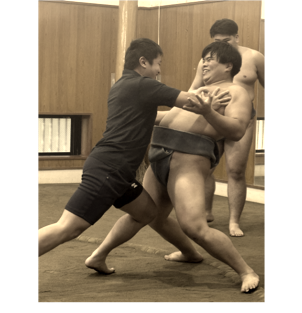
At this point, I was reminded of a statement that has probably been repeated so often it risks becoming a cliché but is worth revisiting: budo is “moving Zen”. Well, it already is a cliché, but it’s a useful phrase as long as we don’t take it too literally. There is a shared orientation, a common concern with the cultivation of the mind.
This is usually where people go wrong. Zen is certainly not confined to the cushion. There is, of course, the quiet, seated practice, the so-called stillness of Zazen. But there is also what older texts call “stillness within movement” that I mentioned above. The ability to remain unmoved in the midst of activity, to act without being dragged around by one’s own thoughts and reactions.
Or as that awesome Edo-period text, Neko-no-Myōjutsu explains, if one merely clings to stillness and forgets movement, that stillness itself is not genuine. Instead, one is easily set in motion by others, like a horse, and what one seeks to “maintain” lacks firmness and balance, offering no assurance against being led astray by the temptations of the outside world. If a person who sits rigidly in the mountains, guarding such stillness, were to be cast into the bustling marketplace, his mind would become confused, and the very state he believed he preserved would prove impossible to sustain.
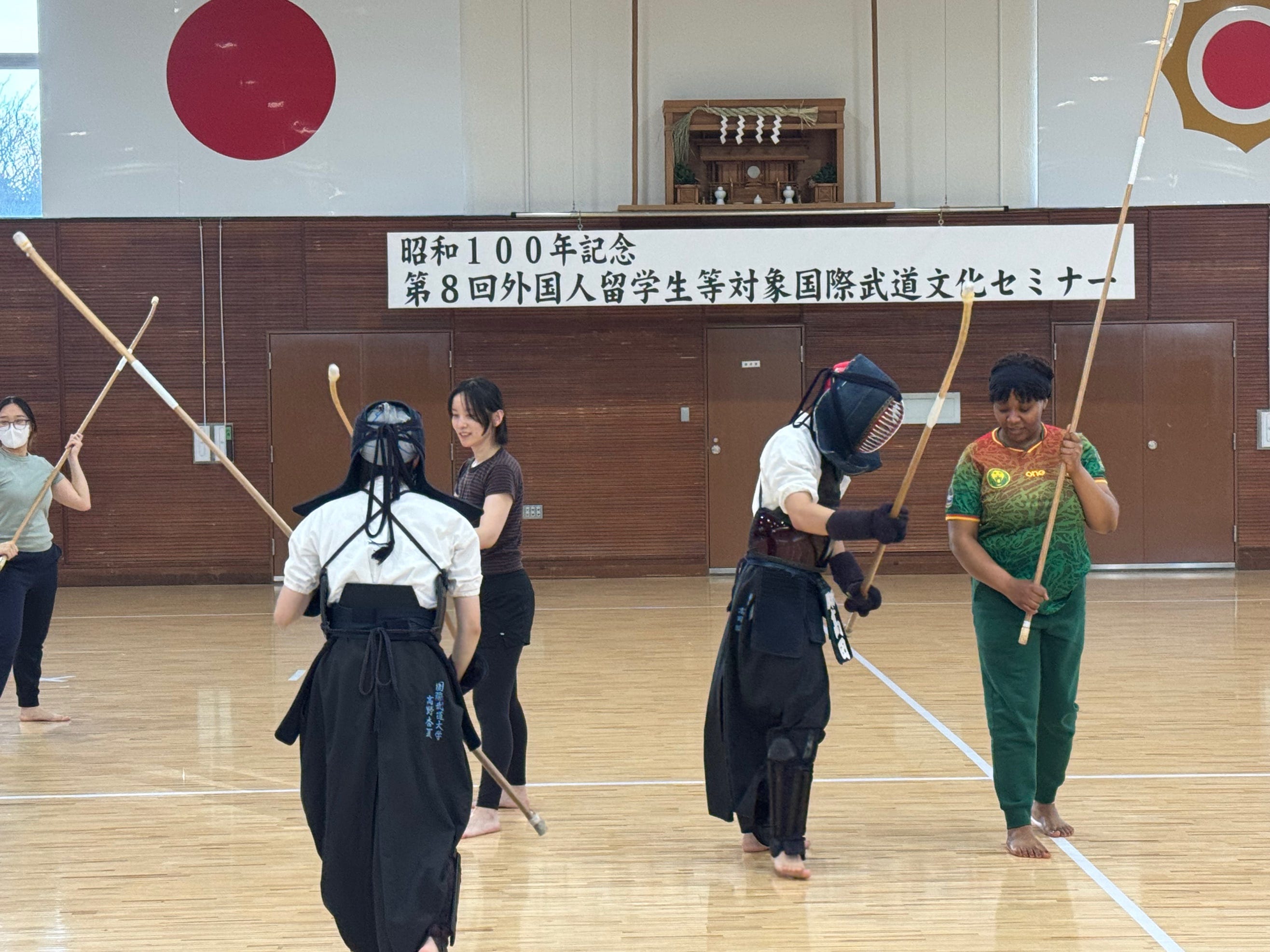
Looked at from that angle, Musashi’s career achievement reads differently. It is often said that others used Zen to elevate their swordsmanship. Musashi, if we believe the old accounts, did the reverse. Again, he cut his way through enough real encounters that whatever clarity he arrived at was already lived, not borrowed from doctrine. By the time he later engaged with Zen more formally, it was less a discovery than a way of explaining something he already understood in his bones.
Back to the lecture. Hirai-sensei then shifted the focus slightly, bringing in Japan’s natural environment. A country of remarkable beauty, shaped by the changing seasons, but also one of frequent, natural disasters. Earthquakes, typhoons, all the usual nasty suspects.
In many cultures, the instinct when faced with nature is to conquer it, to impose control. In Japan, the tendency has often been different. Rather than attempting to dominate, there is an emphasis on coexisting, on finding a way to live within the constraints imposed by the environment.
He quoted a well-known Zen poem:
Spring, flowers
Summer, the cuckoo
Autumn, the moon
Winter, the snow, clear and cold
The point is not that spring is good and winter is bad. Each season is complete in itself. The problem lies not in the external world, but in our tendency to impose our own preferences upon it. Remove those preferences, and every season becomes, in its own way, perfect. The same principle sits underneath both Zen and budo. Let go of the self-centred perspective, and the world changes accordingly.
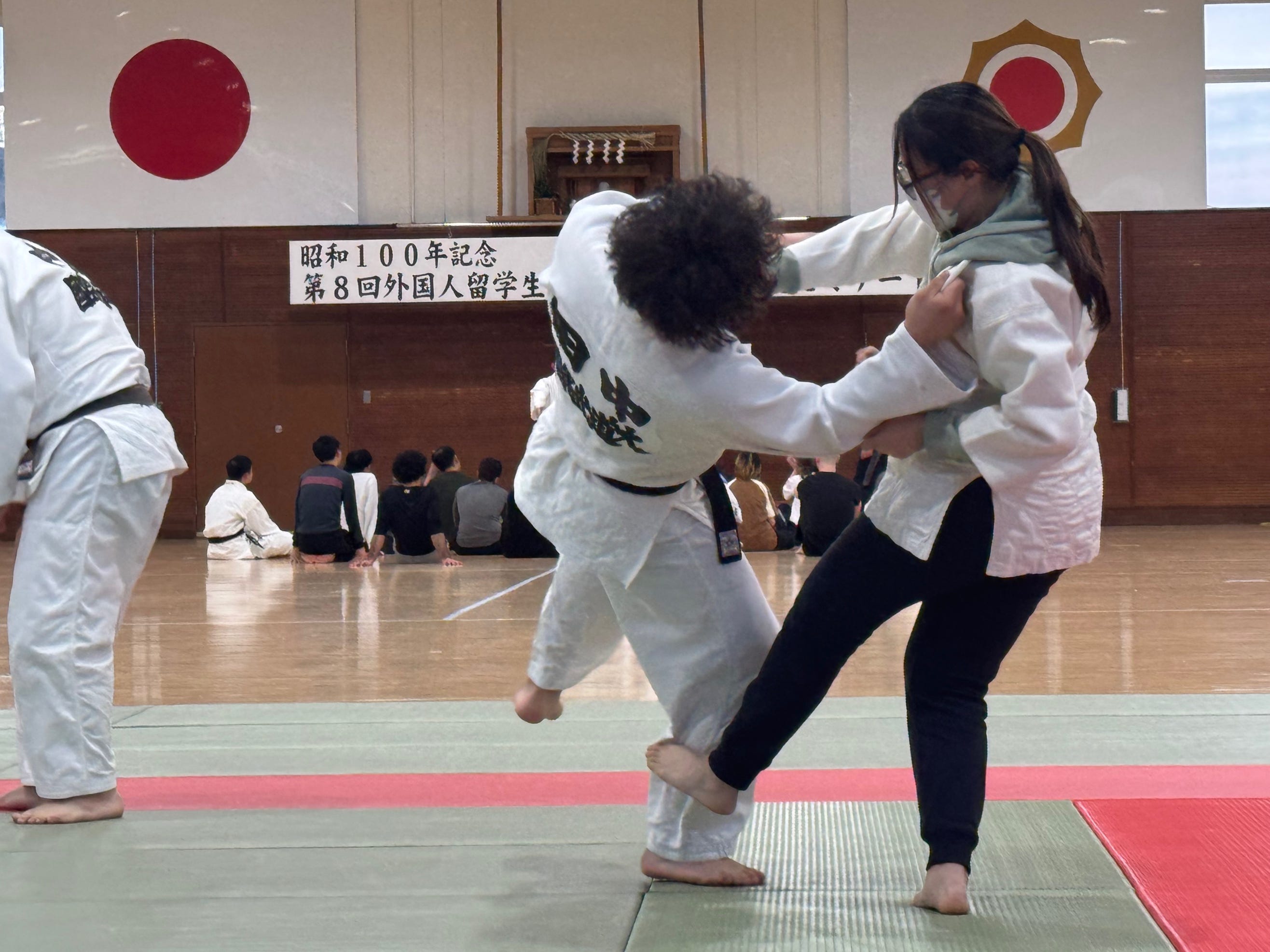
All of this was delivered with a calm clarity that made translating it straightforward enough. The difficulty came afterwards. Because the lecture was followed by a session of Zazen.
Now, sitting in silence for extended periods is not easy. Add to this a room full of international budo newbies, many of whom may have come with a rather romantic notion of what Zen training entails, and you have the makings of an interesting situation.
There is, in Zen practice, a stick. The keisaku. A flat wooden implement used by the priest to strike practitioners across the shoulders. Not as punishment, but as a form of encouragement. In principle, it is used to rouse those drifting into drowsiness or to bring the wandering mind back into focus. Or so the theory goes.
What followed was one of the stranger scenes I have seen in a while. Instead of struggling quietly with their own restless minds, a good number of participants seemed primarily concerned with positioning themselves in such a way as to maximise their chances of being struck.
The priest moved through the room with measured steps, delivering the more than occasional strike with practised precision. Meanwhile, a queue of eager recipients seemed to form in spirit, if not in actual physical space. Being in Zazen mode myself, I couldn’t see what was going on, but the constant whacking and thwacking made it difficult to get the old harmonic mushin engine running. Zen is about letting go of attachments. Yet here we were, collectively developing a new one. The desire to be hit with a stick…
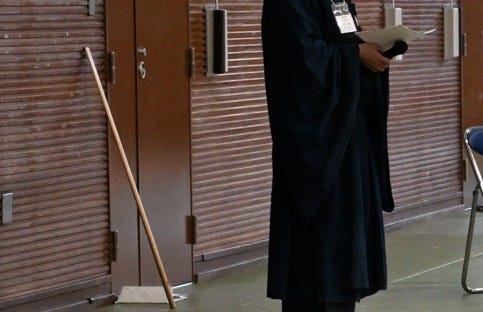
I include myself in this, by the way. There is something oddly compelling about it, which probably says more about us than the practice itself. Perhaps it is the hope of a shortcut. A sudden jolt that will cut through the noise and deliver instant clarity. Or perhaps something more mundane. A desire to experience it, to file it away, and later say “Yup, I did Zazen in Japan, and I was even whacked with a keisaku so it’s the real deal.”
As the participants did as they were told, simply focusing on their breathing in an attempt to steady their minds, the initial excitement faded, and something closer to genuine practice began to emerge. I have been around this long enough to recognise the pattern; in my earlier encounters with Zen I went through much the same, though this time, with a few years under my belt, I found myself comparatively at ease. The room settled. The breathing slowed. I’m sure the inevitable discomfort crept in with knees complaining and thoughts wandering. Time stretched in that peculiar way it does when you are not enjoying yourself.
And in that space, stripped of the theatrics, there was a glimpse, however fleeting, of what the priest had been talking about, though not enough to start making any grand claims. No special powers. No dramatic revelations. Just the quiet, persistent effort to sit, to observe, and to let go.
Afterwards, it seemed to me this is where Zen and budo actually meet. Not in the grand statements or the historical anecdotes, but in the mundane reality of practice. Turning up and just doing the work. There is no great romance in it. Confronting the same limitations day after day, with no guarantee of progress.
It is not glamorous and is rarely comfortable. But given enough time, something does shift. Not because you’ve added anything new, but because you’ve slowly cleared away what was in the way.
So no, Zen and budo are not the same thing. But they have been in conversation for a very long time. And occasionally, if you are lucky, that conversation includes a well-timed whack to remind you that you are not nearly as enlightened as you thought.
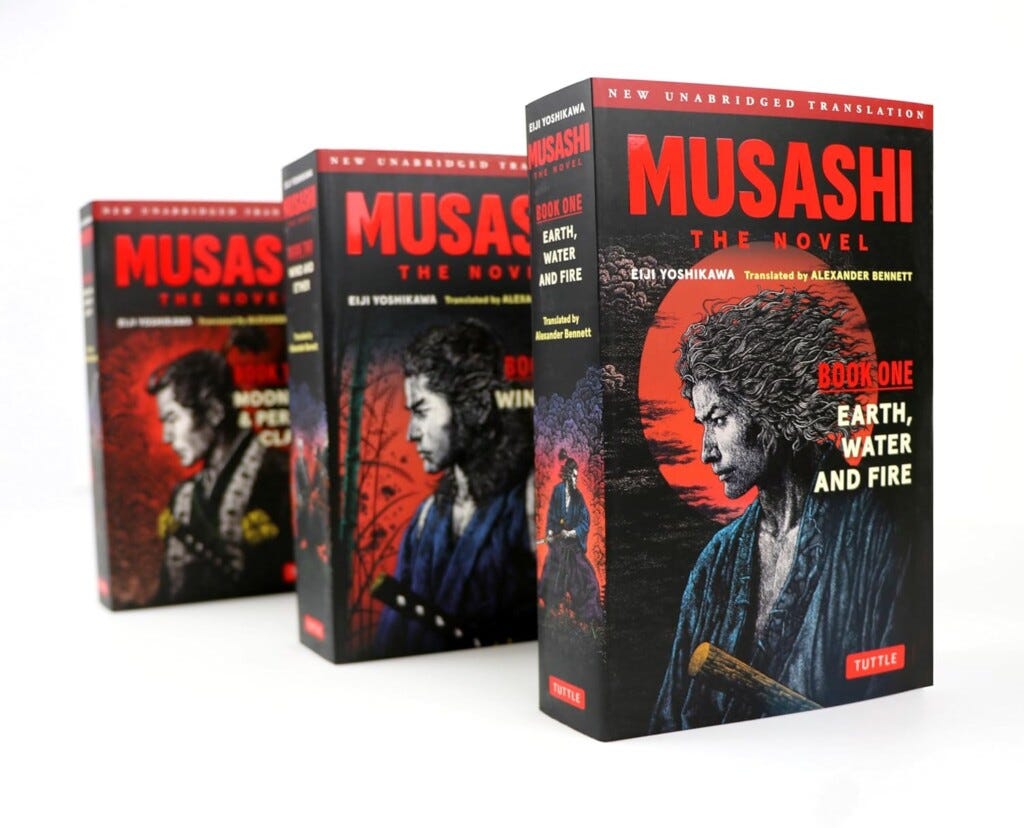



[1] Kawamura Akira, Miyamoto Musashi: Monogatari to shiseki o tazunete (Seibidō Shuppan, 1984) p. 264
List of Related Articles

Budo Beat 67: Same Mountain, Different Paths –...
Budo Beat 38: The Philosophy of Zanshin No. 4 – “Th...
Budo Beat 66: L’Amour de l’Armure – In Apprec...
Budo Beat 26: The Philosophy of Zanshin No. 3 – “Th...

Budo Beat 12: Brass Monkeys Cold, Samurai Bold
No comments yet.