









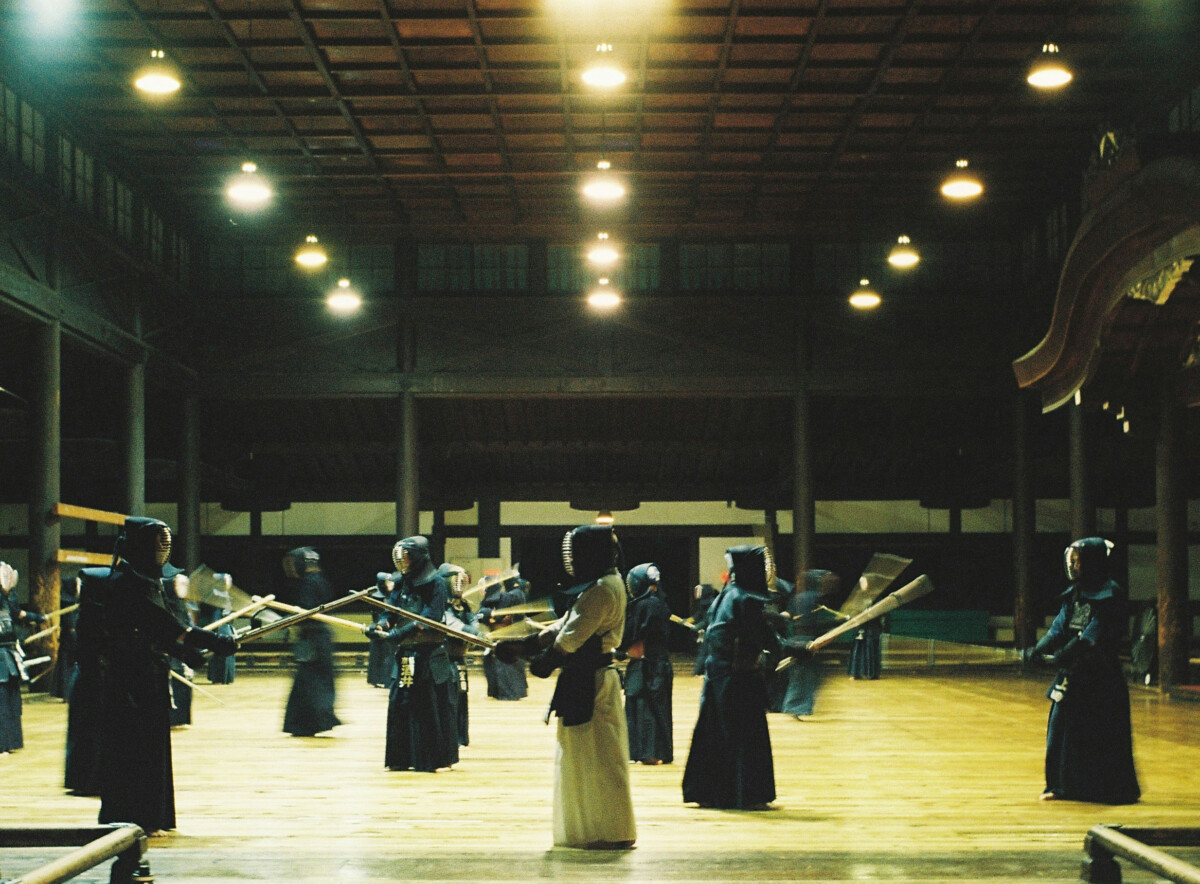
Budo Beat 72: Back to Basics, Again – My Kamae’s “Warrant of Fitness”
The “Budo Beat” Blog features a collection of short reflections, musings, and anecdotes on a wide range of budo topics by Professor Alex Bennett, a seasoned budo scholar and practitioner. I compose digestible and diverse discussions on all things budo, from the philosophy and history, to the practice and culture that shape the martial Way.
A young kendoka, Luka, came all the way out from Croatia to stay at the Jigokuden recently. He was in Japan for a couple of weeks to train and do the budo thing. I guess he had a pretty conventional idea of what he might get from spending some time in Japan. He’d get to watch some decent kendo, pick up a few helpful technical pointers, perhaps be regaled by some gnarly stories about how things were in the bad old days, and then head back home with a clearer picture of what more advanced practice looks like.
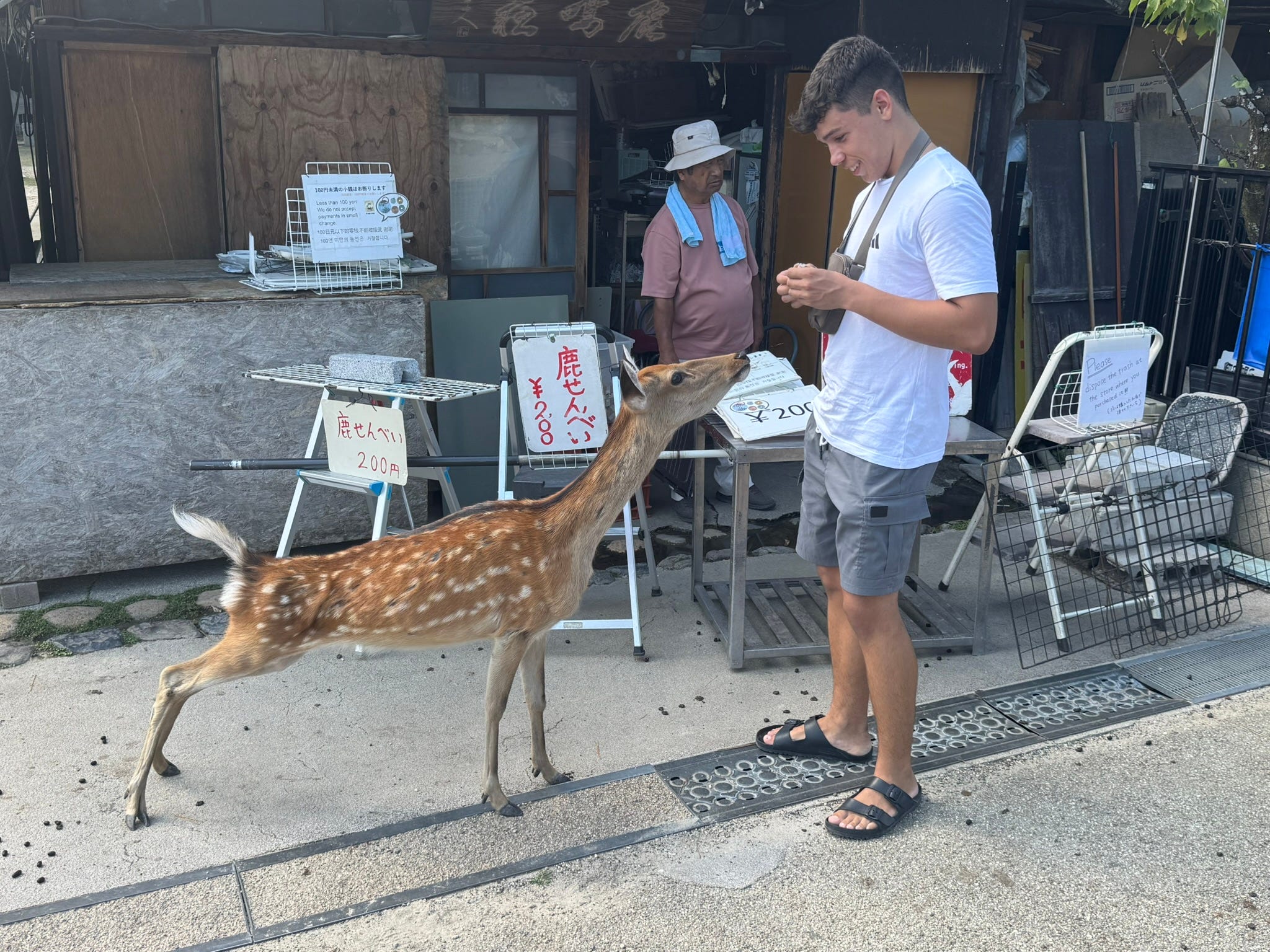
I reckon he got all of that, and the added bonus of getting to watch my kendo being mercilessly dismantled at the world-famous Butokuden in Kyoto.
T-sensei had just sent me a message saying we (as in me) needed to go back to basics.
Sorry to message so late. If it’s no trouble, I’d be happy to come out to the Jigokuden in Uji sometime when you’re free. Shall we take our time and work through things together, starting with the basics?
A very humbling message. He offered to come to the Jigokuden to clean my new floor with me to this end, but decided sooner was better than later so we arranged to meet at the Butokuden the following Monday. The focus of the “basics” was to be my kamae (stance), not some obscure technical point or mysterious discussion about sen, aiki, or the metaphysics of seme. Having said that, it’s all related. A flawed kamae means all of the above falls to bits in the fray. We looked at how I was standing, in what way I was holding the shinai and what precise angle the tip was pointing, what my shoulders and hips were doing, how I was breathing, and how much tension was packed into the whole damned bundle.
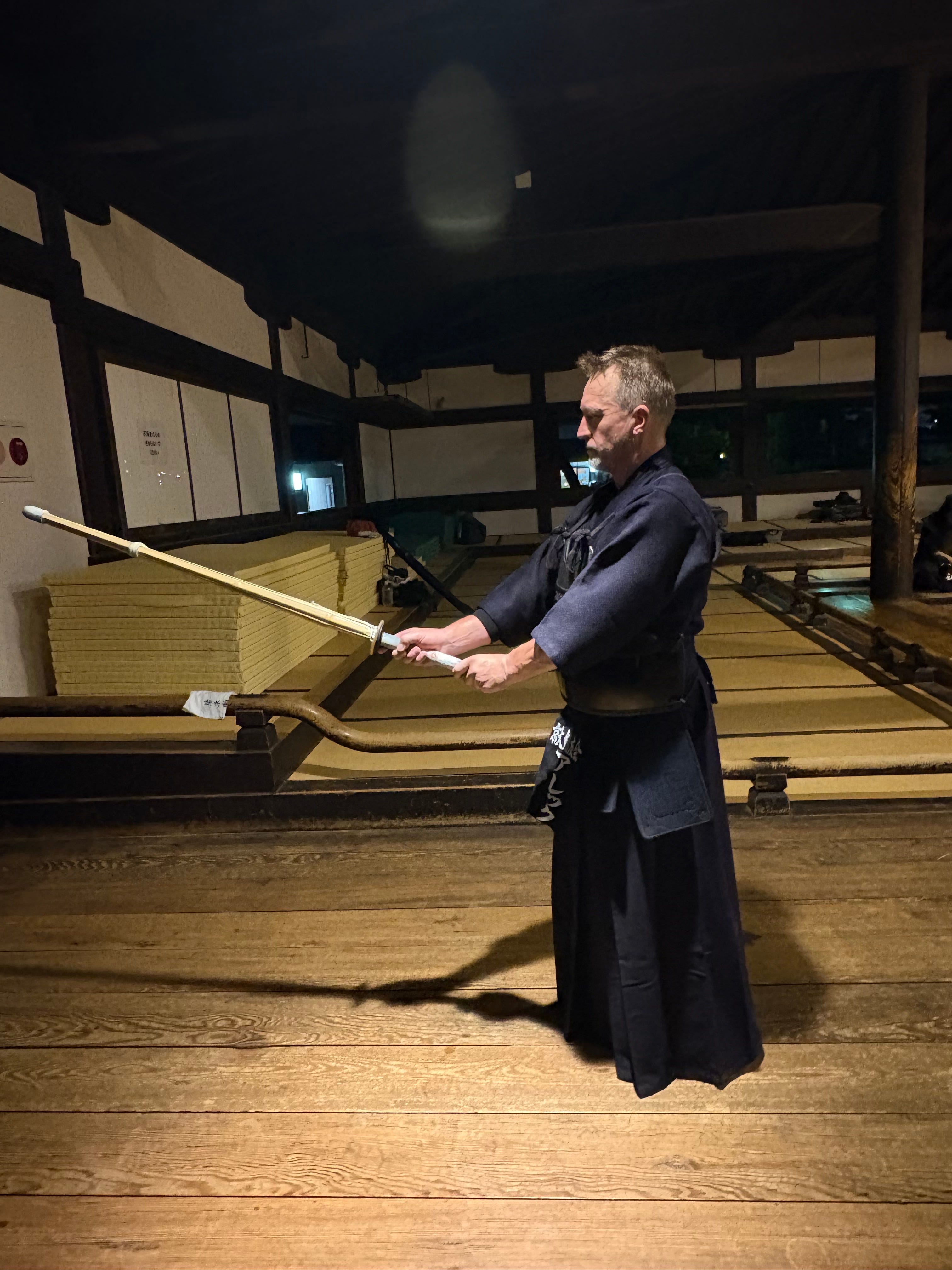
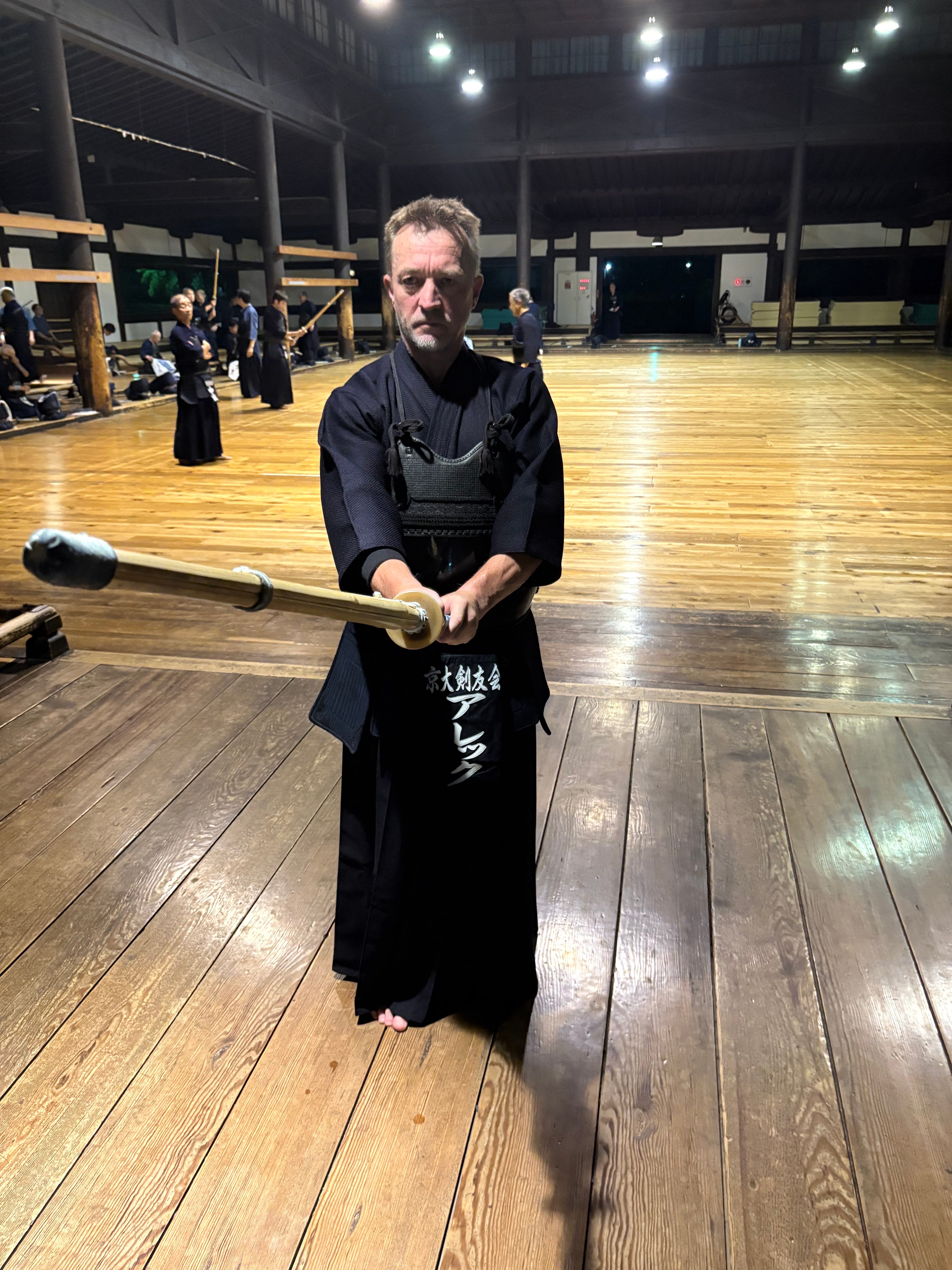
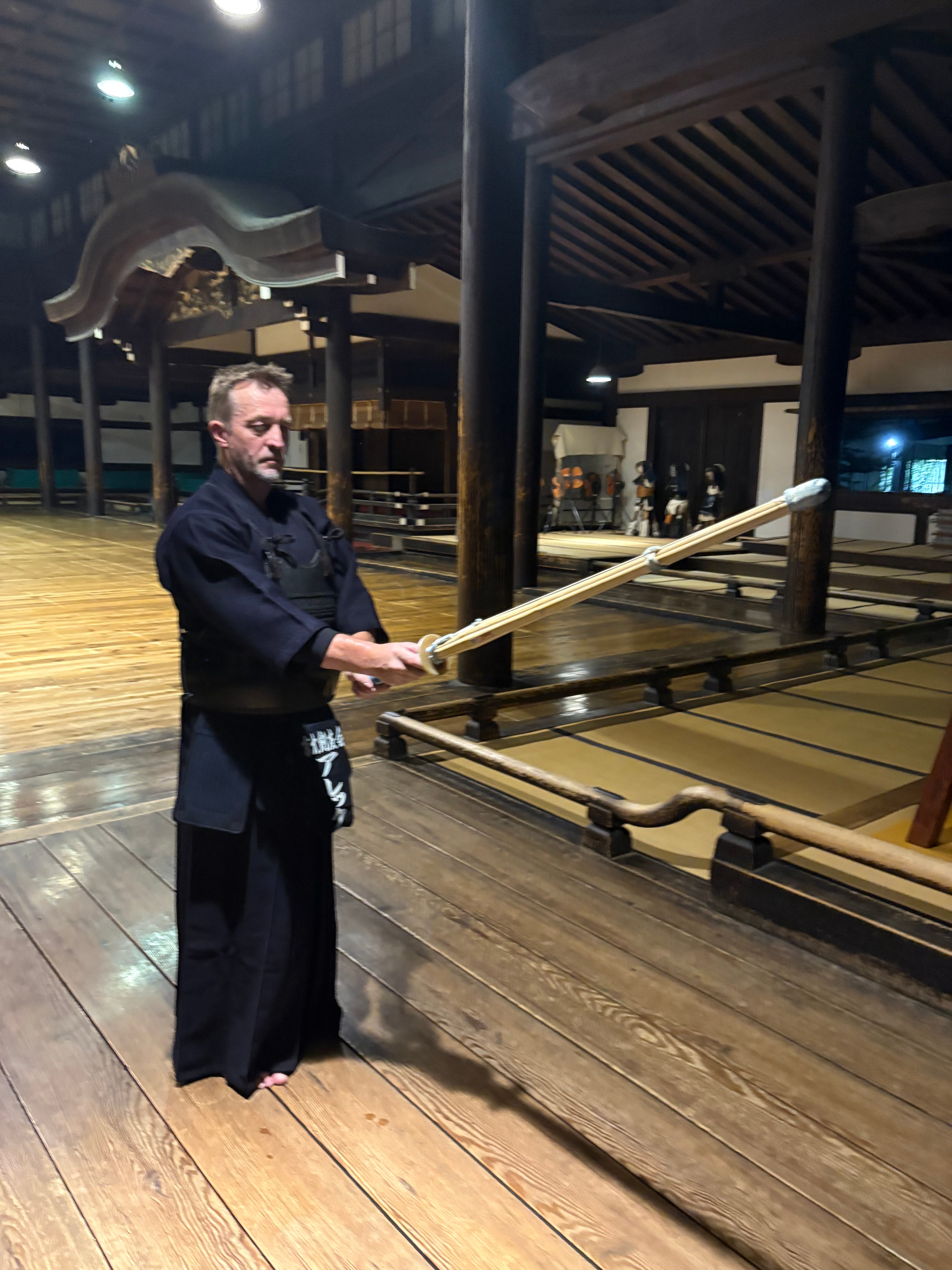
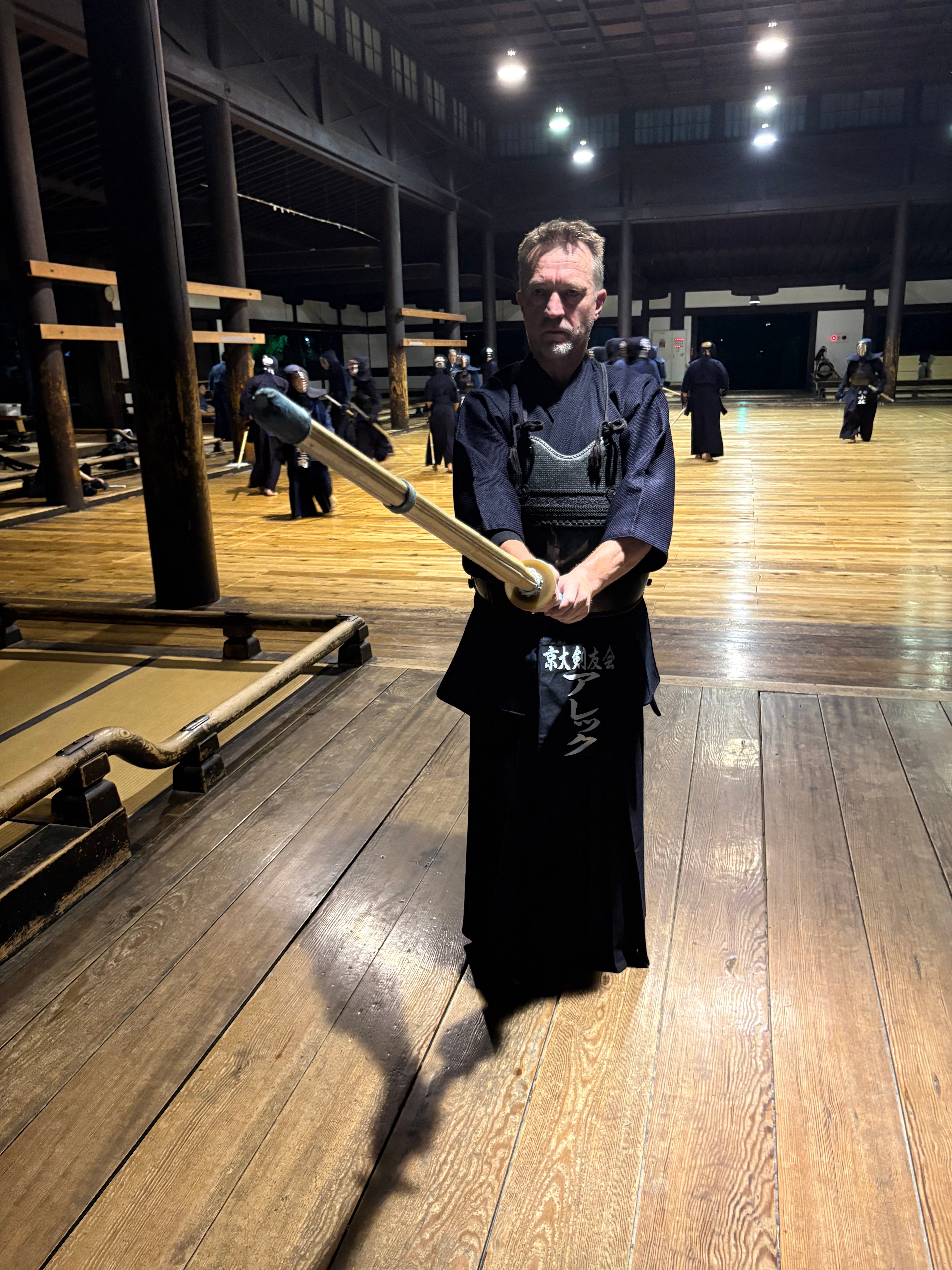
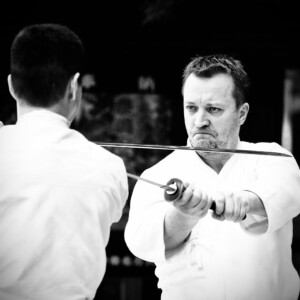
So that’s what we did that warm Monday night with Luka in tow. We went right back to the nuts and bolts of kendo and started pulling things apart. At the end of keiko, he took a whole bunch of photos from various angles (posted here) of what my kamae should look like for reference later on. Luka seemed genuinely surprised. I can’t remember his exact words, but it was something along the lines of, “You’re a bloody 7th Dan. Why do you still need to be taught something as basic as kamae?”
I guess it was a fair question. When you’re still relatively new to budo, there’s a simple assumption that advancement is a cumulative matter. You start off by learning the basics, then progressively move on to more complex things. Kamae, footwork and striking form the foundation. Once these basic elements have been dealt with so that you look like the real deal, you start ascending into the more enigmatic higher floors and secret rooms of the building. By the time you reach 7th Dan, one would think that the business of “standing properly” has long since been mastered. Alas, this is not the case.
The problem is that once you start fiddling with the building blocks, it can very easily knock everything else out of kilter, and eventually you have to go back to the drawing board. I’ve been most fortunate over the years to receive instruction and advice from some awe-inspiring teachers. As I have blogged about many times in the past, the 8th Dan challenge is giving me more than a few things to ponder in my training. The advice I have received includes but is not limited to such things as: “Take the initiative.” “Use your opponent.” “Strike at the start of their movement and don’t force the opportunity.” “Kill the opponent’s ki. And their shinai. And their waza!” “Don’t forget to breathe properly, you moron.” “Don’t make the breathing obvious, you moron.” “You moron…”
All of it is good counsel, and taken one point at a time, it does make sense. The trouble starts when all of it turns up for keiko at once. At some stage I’d become so hellbent on trying to perform good kendo that I was no longer simply doing kendo anymore. There always seems to be another item on the internal checklist that needs to be ticked off. What’s my left hand doing? Where’s the kensen pointing? Is this real sen or am I just reacting? Oh shit, he hit me! I really am a moron…
That’s why T-sensei’s LINE message was a well-timed reminder that not all was lost. Essentially, he was not suggesting that I needed yet another byzantine idea to chuck in the mix. He was pointing out that the all-important structure underneath all those ideas needed a “Warrant of Fitness”. (A Kiwi term, I think. A compulsory vehicle inspection to make sure your car is road worthy!)
There was “too much going on” in my kamae, which ironically meant that there was not enough going on. To use T-sensei’s words, “Your kamae is too small and that’s strangling your kendo.” In short, there was too much effort going into making the shape nice and correct, and because of that, I was just standing there in a stifled state in which there was little room for spontaneity. In other words, I was already half committed to what I ‘imagined’ should happen next.

I’m committed to keeping my work freely accessible to all budo enthusiasts, wherever they are. If you’ve enjoyed what you’ve found here and would like to support my ongoing efforts and projects, “buying me a coffee” (beer actually), or my books, would make a world of difference.
If somebody had taken a photograph of my kamae, there probably wouldn’t have been too much dramatically wrong with my stance on the surface. My hands were more or less where they were supposed to be. I think my shinai was pointing in the right general direction, and my feet were not doing anything scandalous. My posture was also upright and not too shabby to look at. But T-sensei was reminding me that kamae is not meant to be a perfect pose you assemble yourself into before the real business starts. “It’s already part of the encounter”, he said, “where your breathing, readiness, application of pressure, ability to move, and the relationship with the person opposite are all in there.” It had to be natural, and that was the bit I had managed to complicate with all the bits of advice I had been getting over the years. Apparently, I had moved away from what my body and mind feel to be truly natural.
To be clear, I’m not learning how to stand for the first time. Instead, I’m trying to work out what has crept into the way I stand, and what can be removed or tweaked for maximum efficiency and effect. In a nutshell, holding my left hand slightly off my centreline with my kensen marginally higher pointing at my opponent’s left eye, my blade on a slender downward angle to the left, my hips turned faintly in has brought me back to my own kendo. We are only talking about millimetres here, but what a massive difference it has made.
Which is why we are always being told to go back to basics. Zeami, the medieval Noh actor, playwright and theorist, expressed something relevant to this in his famous teaching, “shoshin wasuru bekarazu”. It means “never forget your beginner’s mind”. This means that every stage of development brings various challenges and new lessons to mull over. I’ve been reminded of this as T-sensei reteaches me my kamae, something I learned when I first picked up a shinai forty or so years ago. Those decades of training allow me to see things I could never have understood as a beginner, but they can also make familiar habits difficult to question. Being taught how to stand and hold the shinai again requires me to listen humbly and accept that something so ridiculously fundamental still has so much to teach me.
This is probably what surprised the Croatian lad Luka most. He perhaps had the understandable assumption that seniority meant you had pretty much mastered the basics. What he saw instead, I hope, was that the basics always need to be worked on. If anything, they become less forgiving as you advance.
So, for the moment, I’m back working on kamae. I owe T-sensei a lot for dragging me back there. There’s still plenty to do, but being reminded of how to stand again in my own kamae has proved surprisingly liberating in the weeks since. I certainly feel less inhibited in front of my opponent. There’s less to organise before I’ve even started, and a little more room to see what is actually happening… All the pieces are slowly falling back into place.




No comments yet.