












Budo Beat 70: It Came from Akimura-san – The Soul of a Warrior
The “Budo Beat” Blog features a collection of short reflections, musings, and anecdotes on a wide range of budo topics by Professor Alex Bennett, a seasoned budo scholar and practitioner. Dive into digestible and diverse discussions on all things budo—from the philosophy and history to the practice and culture that shape the martial Way.
It’s not a particularly difficult word to understand, especially compared to some of the more esoteric concepts I mangle in my blog. “Bukon”. Bu (武) = martial, + kon (魂) = soul or spirit. Put together and the meaning is self-explanatory. If you peel away the historical baggage, which I will attempt to do shortly, it expresses a forthright ideal of discipline and courage based on the “spirit of the warrior”. Or, less literally, the qualities of character cultivated through the study of the martial arts.
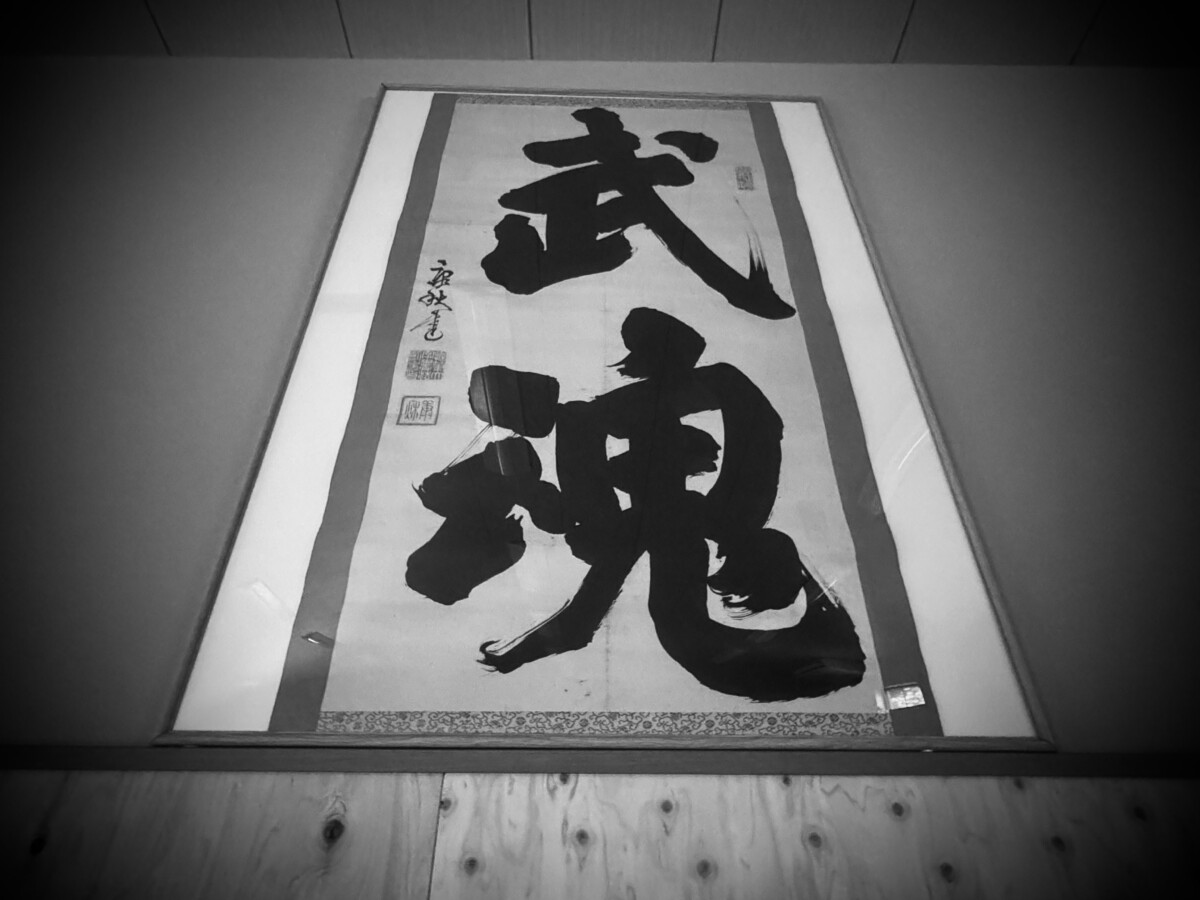
I’d heard of the term before but never dwelled on it until I was presented with a magnificent kakejiku with the two kanji boldly, almost brazenly, brushed onto the paper. I now have it displayed prominently in the Jigokuden. People frequently ask me about it, so that got me thinking about whence the piece came.
For the decades I’ve spent reading Edo-period texts on swordsmanship, warrior ethics and culture, and all sorts of samurai stuff, I don’t recall ever actually seeing 武魂 in any dusty old document. There’s probably a reason for that. I’m of the belief that words retain a certain texture, a kind of spirit if you like, and some feel more at home in certain periods. Bukon strikes me as being of a somewhat modern epoch, around the Meiji period in late 19th~early 20th century.
That said, the ideas behind “martial spirit” are old enough. Samurai of the Edo-period (1603-1868) and before wrote ad nauseum about virtues such as valor, fighting spirit, self-control, honour, facing death with equanimity, and how the mind should remain unperturbed when the kuso hits the senpūki. They were never short of descriptions for the bricks of martial character, and the appellation bukon seems to fit the bill perfectly. Notwithstanding, something about bukon resonates with me as being a little different. It’s a punchy word, pun intended, and almost seems like a slogan, which is why I reckon it’s a product of modern Japan.
One earlyish example I managed to dig up features in the writing of Oshikawa Shunrō (1876-1914). Oshikawa was an adventure writer of some repute, and a pioneer of the science fiction genre in Japan. He was one of those peppy characters who embodied the verve and muscular atmosphere of Meiji-era Japan. Oshikawa was an enthusiastic supporter of sport (his brother formed the first professional baseball team in Japan), and famously crossed swords with none other than Nitobe Inazō, who was among those arguing that baseball somehow exerted a harmful influence on Japanese youth.
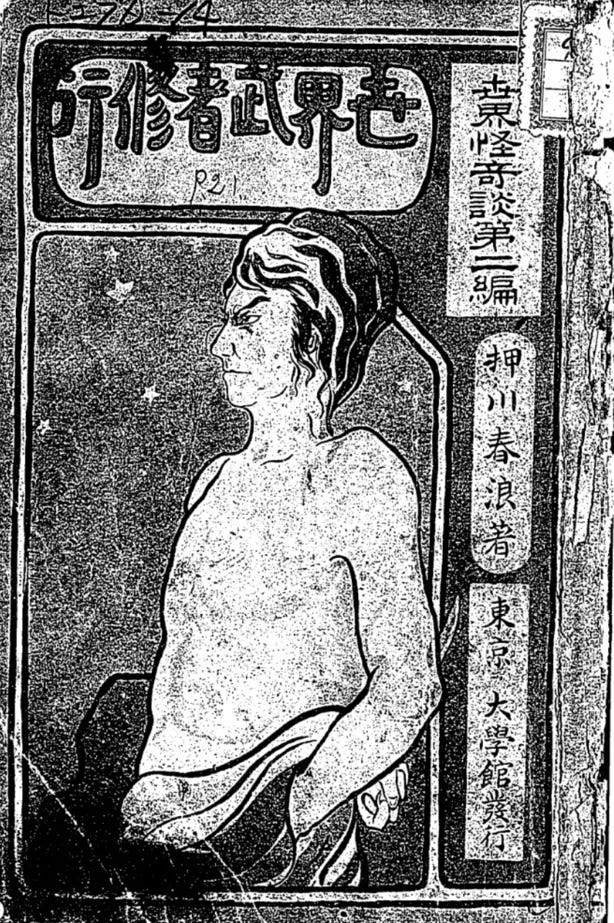
Anyway, in his 1902 book Sekai Musha Shugyō (World Heroic Journey) he refers to bukon as the indomitable martial spirit that links an innate Japanese temperament with physical courage, masculinity, and of course, good olde bushido. He also laments that the comforts of modern civilisation were making young Japanese into a bunch of big softies. In this and some of his later books, he linked bukon with “character and vitality”, which, by virtue of their DNA, any blue-blooded Japanese person worth their salt should have inherited from the samurai. After all, this is what makes Japan so unique in the world. A few years later Oshikawa expressed this sentiment in very hawkish terms as a warning against negligence in the big wide world.
From this day forward, the so-called ‘civilised age of warring states’ will continue for a long time to come. Matters that cannot ultimately be resolved through diplomacy will inevitably be settled by war. The great powers will therefore compete ever more fiercely to improve and develop their weapons and expand their military strength. Since military power is, as a rule, proportionate to a nation’s wealth, we must regrettably assume that the Western powers, whose financial resources far exceed our own, will always possess more battleships, more artillery, and more aircraft than Japan. And if, in addition, they should come to possess the same fierce martial spirit (bukon) that the Japanese people have traditionally possessed, can we truly continue to sleep soundly at night?[1]
I am by no means suggesting Oshikawa invented the term bukon. In fact, I would be extremely surprised if he did. Earlier examples undoubtedly exist somewhere, and I’ll continue my search for something more definitive. One thing I can say with surety is that bukon became firmly established in jingoistic rhetoric in the twentieth century.
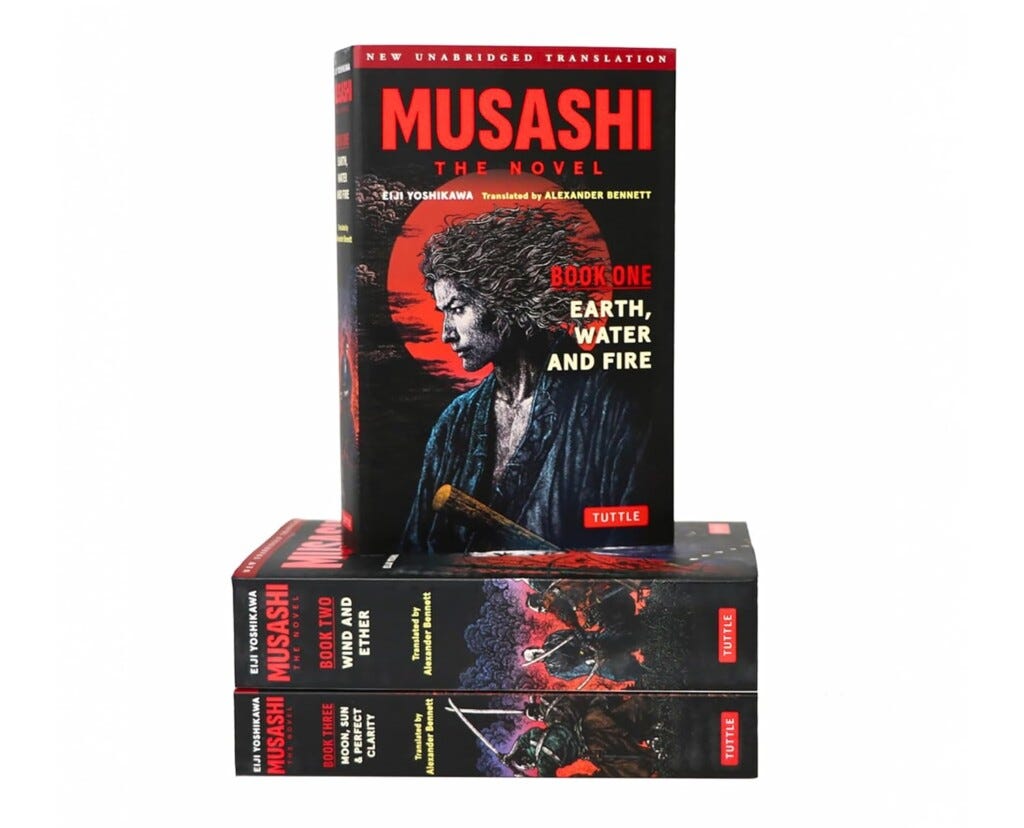
My old mate Yoshikawa Eiji used the word too, and quite matter-of-factly, which suggests that by the 1930s the term required no explanation. In Miyamoto Musashi, for example, there is a scene where Yagyū Hyōgo watches the young Ushinosuke come at him with a wooden sword and decides in the moment, “This boy’s got bukon.” I was tempted to translate this as “The little fella’s got some serious balls!” Uncharacteristically, I refrained from taking such poetic license but that’s fundamentally what he meant. In any case, by Yoshikawa’s day, bukon seems to have nestled itself comfortably into the vocabulary of heroic martial masculinity.
I should add that none of this makes bukon a baleful word in itself. Words are by nature promiscuous things, and the virtues associated with bukon like courage, toughness, fortitude, and the nurturing of character through physical pursuits were not the exclusive property of militarists and nationalists. In other words, bukon was not necessarily militaristic, but it was useful. The military could embrace it, for sure, but so could budoka, athletes, novelists, and pretty much anybody. The vessel remained the same, but what people decided to pour into it depended on the times.

I’m committed to keeping my work freely accessible to all budo enthusiasts, wherever they are. If you’ve enjoyed what you’ve found here and would like to support my ongoing efforts and projects, “buying me a coffee” (beer actually), or my books, would make a world of difference.
It reminds me of another Meiji-era term that was bandied about with considerable enthusiasm, and I suspect this is why bukon caught on. Any aficionado of Japanese history has undoubtedly come across the term “Wakon yōsai” (和魂洋才). This translates as “Japanese spirit, Western learning”. It’s one of those quintessentially succinct Meiji formulas that made a topsy-turvy period of national anxiety sound almost well-regulated. Japan could import steam engines, weaponry, medicine, top hats and trousers, Tom Cruise, legal and constitutional theory, and anything else from the West deemed to be worthwhile, provided it remembered to keep its “soul” intact. Modernise with Western technology and systems? Hai, by all means. Sell your soul to the West? Not on your Nippon nelly!
So, the publication of Oshikawa’s books towards the end of the Meiji period serves as a useful pointer. Class distinctions had been dismantled four decades earlier after the Meiji Restoration (1868), yet samurai sentiments were enjoying a second life. Warrior ideals were being reinterpreted and intravenously fed to soldiers, schoolchildren, capitalists, athletes, and ordinary Joe Tanakas. The samurai existed no more, but the “samurai spirit” permeated the nation’s political, cultural, and social fabric like smoke from a summer BBQ. Bukon certainly sounds and feels as if it hails from antiquity, but the term is really a modern packaging of older ideals.
Even Nitobe Inazō’s Bushido: The Soul of Japan (1899) had the “soul” subtitle from the outset, as though the entire moral inheritance of the samurai might be decanted into a sake bottle and labelled for export. As far as I know, he didn’t use the term bukon as such in his writings, but the conceptual kinship is unmistakable. Both belong to the same Meiji obsession of turning samurai ideals into the lifeblood of national essence. “Bukon” was essentially thought of as “wakon” with a martial slant, which makes it even more curious that I ended up with such a commanding specimen on my dojo wall. So, how did this come to pass?
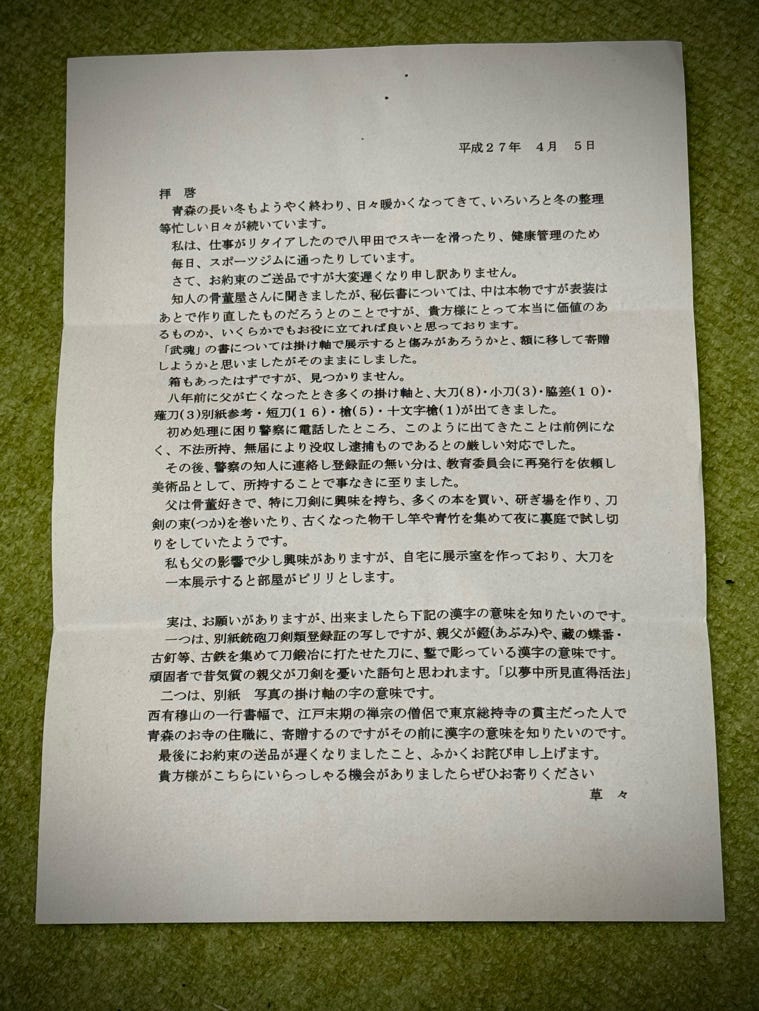
A few years ago, in 2015, a lovely old gentleman from Aomori named Akimura Fumio contacted me out of the blue. He was a recently-retired mountain rescuer, so clearly a man of immense resolve and reslience. He’d come across an interview I had done in some magazine and decided, for reasons known only to himself, that I might be a decent enough bloke to look after a collection of swords and scrolls inherited from his father. His father had been an antique collector and had amassed quite an enviable assortment of bric-a-brac over his lifetime. Akimura-san and his wife weren’t getting any younger, and as they were childless, he was concerned about what would become of the collection after they were gone.
“Would you like some of the swords?” he wrote. “I know you’ll cherish them and show them to people interested in Japanese culture. Please promise me that.”
There are some offers in life that require careful consideration, and this was definitely not one of them! I drove from Kyoto to Aomori, a decent thousand km trip to the upper reaches of the country. Akimura-san and his wife welcomed me into their home, and I stayed for several days enjoying their generous hospitality. He regaled me with many stories of his own adventures deep in the rugged mountains of Aomori. He was an incredibly humble man, and although he never said so explicitly, I came away with the distinct impression that he’d spent his whole career risking his life to save others in distress. A true warrior if ever there was one.
Eventually, I loaded the swords and various other objects into the car, and that, I lament to this day, was the last time I ever saw him.
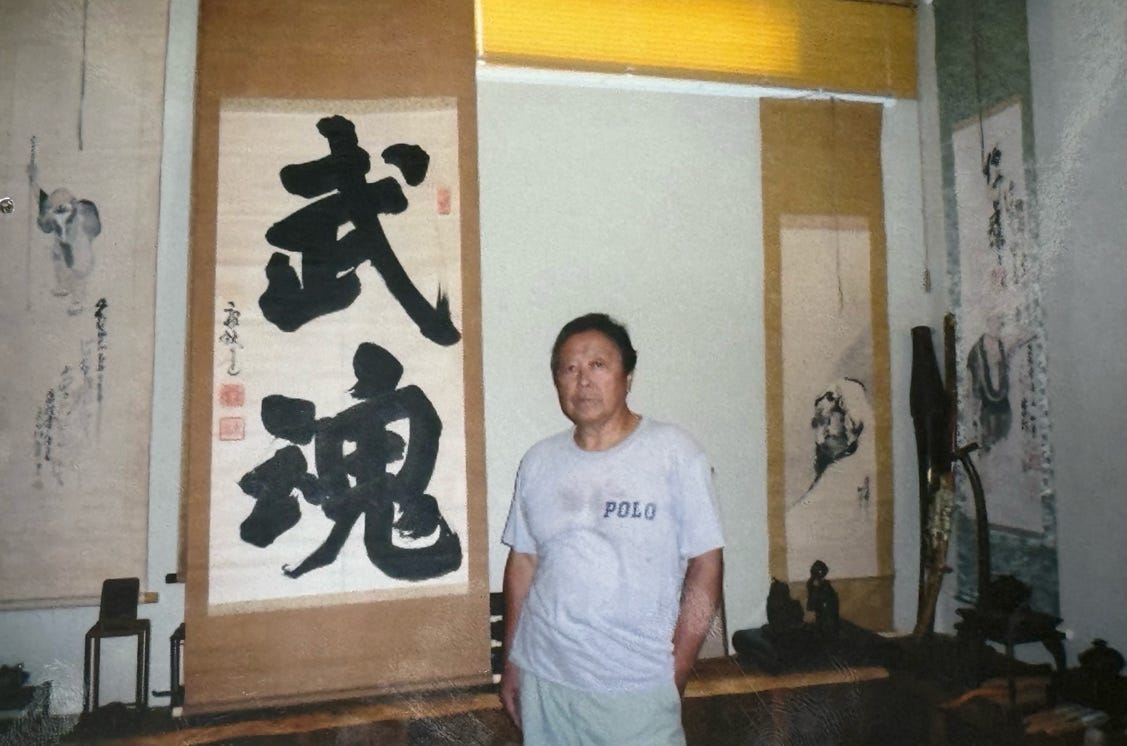
Among the items he bestowed upon me was the large bukon calligraphy. Akimura-san informed me that it had hung in the Aomori Police dojo for many years. How his father acquired it is unclear. There is another problem. Despite ongoing efforts, I am yet to establish who actually wrote it. I have scrutinised the signature and seals and showed them to several calligraphy experts who know about such things. I’ve followed leads that looked promising, but nothing decisive has come to pass as of yet.
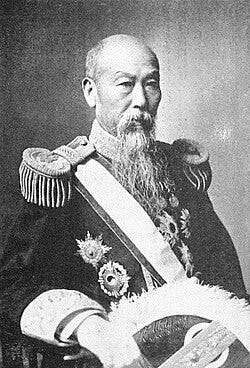
One theory that I particularly like was proposed by my kendo buddy, Morioka Hiromitsu-sensei. He posted the following on my FB just the other day.
The first president of the Dai-Nippon Butokukai, which was established in the Meiji period to oversee Japan’s martial arts, was Watanabe Chiaki, who was governor of Kyoto Prefecture at the time. Since the calligraphic signature reads ‘Keishū sho’ (慶秋書, ‘written by Keishū’), it’s possible that ‘Keishū’ was a pen name used by Watanabe Chiaki. However, no source confirming this has yet been found, so for now this remains purely speculative.
Oh, I wish! If indeed it was Watanabe Chiaki, he’s a legend in the formation of modern kendo, and I’ve written about him in the past. And there’s more. My dear naginata teacher, Kimura-Yasuko, is a direct descendant of Watanabe Chiaki, so the connection would be too perfect. The sort of karmic stitch in the cosmic web that makes me wonder whether the universe amuses itself with footnotes. I do hope this is a genuine footnote, but I’m sure the truth will be revealed sooner or later. If only I had thought to confirm such details with Akimura-san when I had the chance! For the meantime, however, the hand that brushed the characters remains a mystery of time.
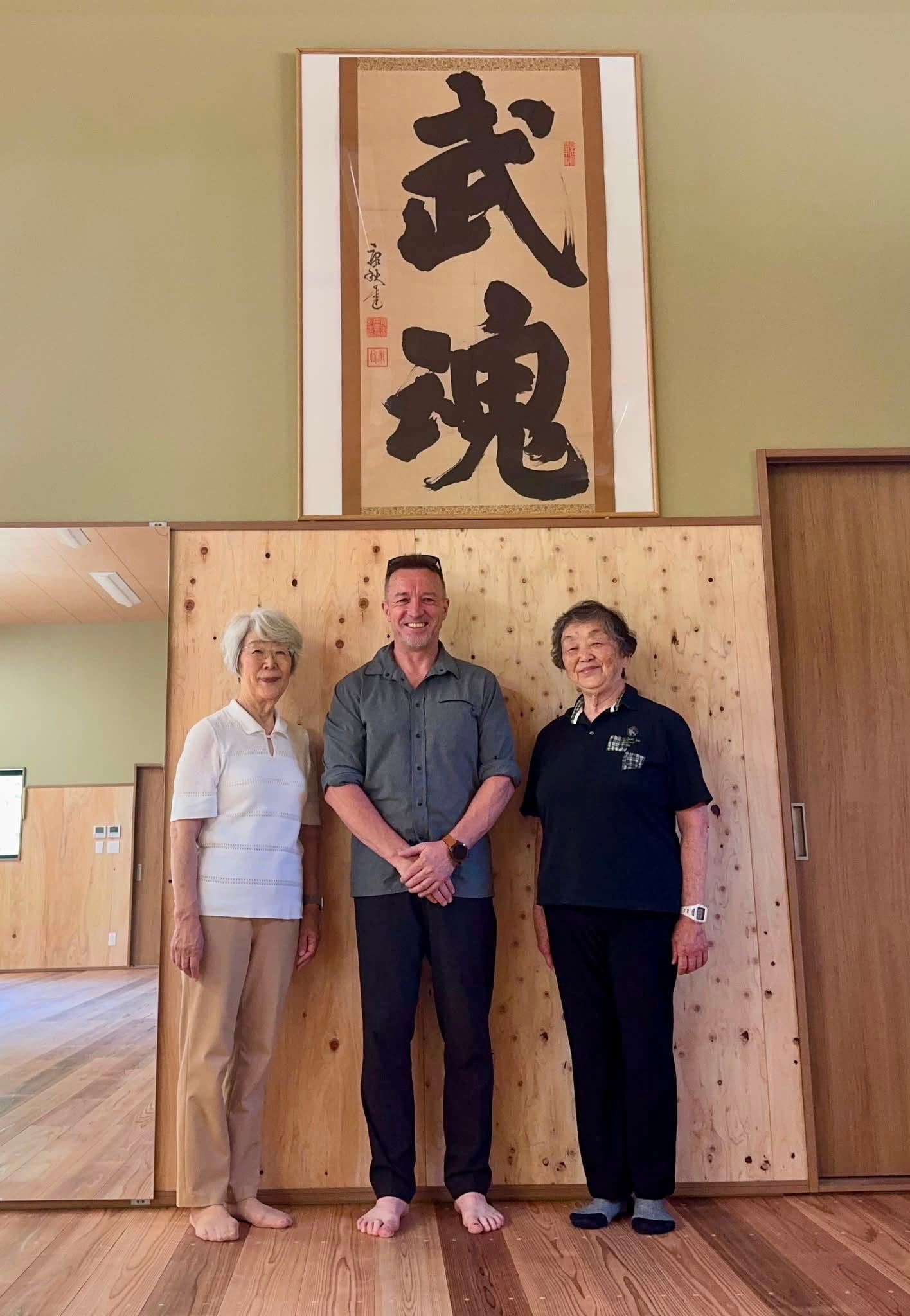
For several years I was a tad unsure what to do with it. I knew it was special, but bukon does not sit unobtrusively in the background. The kanji characters are so bold and commanding, the kakejiku needed a worthy space to shine its light. Building the Jigokuden in Uji made the answer obvious. It has found a loving home.
Unfortunately, Akimura-san never saw it hanging there. I received a call from his wife about five years ago as I was dozing off. She said her husband wanted to sing me a song. And, so he did. He sang with passion over the phone, and I could imagine the tears rolling down his face. I don’t know exactly what it was, but I guess it was an old Aomori folk song.
I just listened respectfully, and didn’t know quite what to say when he had finished. I think his wife shared my embarrassment, but I knew something was up. A little while later, as I feared, he died.
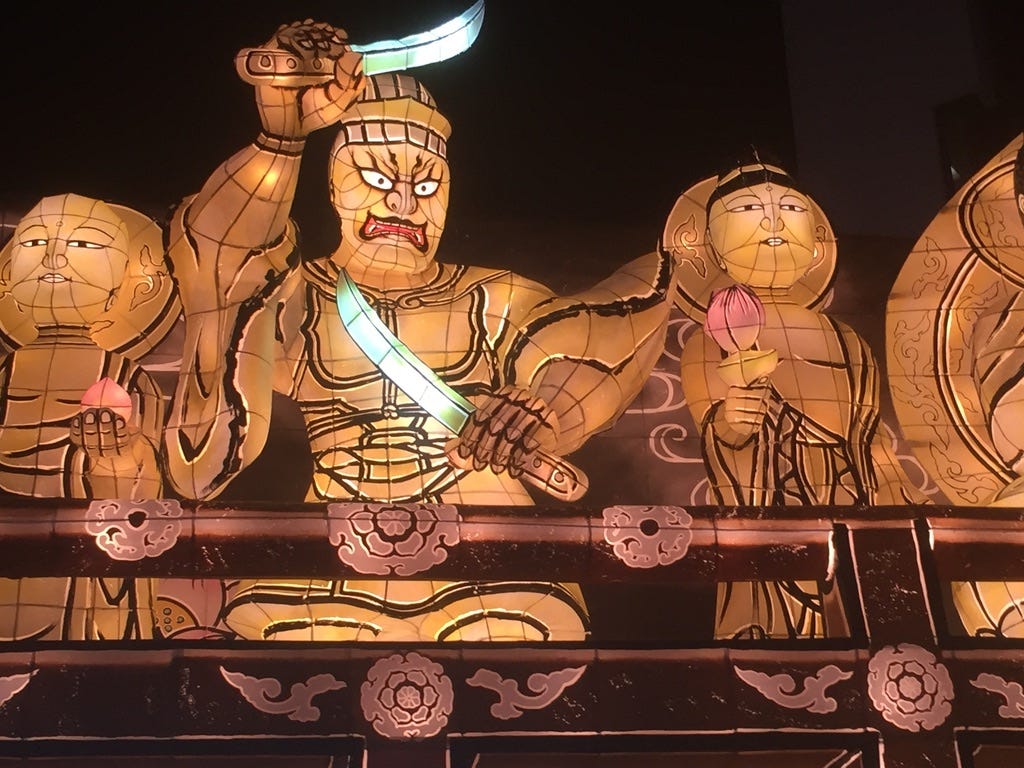
And now, not a day goes by when I don’t think of Akimura-san. I see that scroll on the wall every day, and think about the kindly old mountain man who entrusted it to me. I hope I can find out more about its provenance from an academic perspective, but it doesn’t really matter at the end of the day. That’s because the process of writing this blog post woke me up to something more important. I know whence it came.
It came from Akimura-san.
[1] “Keikai Subeki Nippon” in Bōken no Sekai (December, 1910). Reproduced in Meiji Daizasshi: Fukuroku-ban (Tokyo: Ryūdō Shuppan, December 1978) p. 175




No comments yet.