












Budo Beat 65: Dead Serious about Honki – Why the most ordinary Japanese word may be the most demanding one in budo
The “Budo Beat” Blog features a collection of short reflections, musings, and anecdotes on a wide range of budo topics by Professor Alex Bennett, a seasoned budo scholar and practitioner. Dive into digestible and diverse discussions on all things budo—from the philosophy and history to the practice and culture that shape the martial Way.
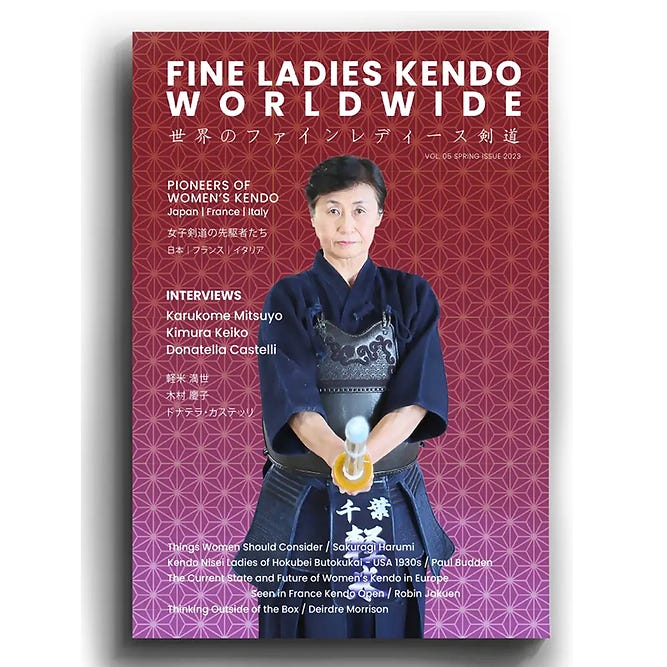
Last week I went to interview Mrs. Karukome Mitsuyo for an upcoming Nippon Budokan video series called “Humans of Budo”. She is a school teacher, and one of Japan’s leading women kenshi.
When I have the chance to interview such senior budo teachers, I often finish things off with the same question. “If you had to sum up budo in one word, what would it be?” It is not especially original, but it usually elicits an interesting answer.
Some sensei pause for a long time before answering. Others have clearly thought about such things before and reply almost immediately. The words that come back are often what one might expect after a lifetime in the dojo: reigi (etiquette), makoto (sincerity), shugyō or keiko (hard-arse training), kansha (gratitude), keizoku (continuity), and so on. Mine would be zanshin. These are all good, worthy words and concepts that can be unpacked forever. In fact, I have a book coming out next month called Zanshin no Tetsugaku. (More on that in a later post.)
When I put the question to Karukome-sensei in Chiba recently, however, she didn’t hesitate. “Honki”, she said. I had to do a second take. For a split second, I wondered whether it was an offhanded joke at the expense of the resident white bloke.
Honki? Really? After more than forty years in Japan, it is one of those words I hear so often that I had almost stopped hearing it. People are told to work honki de. Students are told to study honki de (with honki) It has some of the same feel as the more familiar maji de, but honki carries more weight and less slang. And if someone makes a mess of something important, people can get honki de pissed off, too. It is not an obscure term from a Zen text, nor one of those impressive budo expressions that becomes more mysterious the longer people try to explain it. It is totally ordinary Japanese. Everyday Japanese. The sort of word a five-year-old understands perfectly well.
And yet, as is so often the case in Japan, the most ordinary words sometimes turn out to be the most difficult to translate properly. Honki is usually rendered as “seriousness”, “earnestness”, or “real intent”. None of these is wrong, but none quite does the job either. The word is written 本気: hon (本), meaning “real”, “true”, or “main”, and ki (気), that endlessly useful character suggesting spirit, energy, intention, mood, or inner force.
Taken together, it is not just seriousness in the abstract, but one’s true energy or genuine intention brought fully to bear. “Seriousness” in English can sound a bit stiff, even gloomy. “Earnestness” has a faintly Victorian smell about it. “Real intent” is closer, but still a little clinical. Honki has more flesh on it than that. It means that one is not playing at something. One is not hedging or keeping an exit open in case things become inconvenient. It means that the thing before you has been accepted completely, with no clever little reservation tucked away at the back of the mind. It’s all or nothing, seriously for real.
Karukome-sensei then introduced a poem called “Honki” by Sakamura Shinmin that had clearly made a deep impression on her.[1]
A rough translation follows:
When you truly commit yourself with honki, the world begins to change. You begin to change. If nothing has changed, that is proof you have not truly committed. Love, when it is real. Work, when it is real. A person must, at least once, take hold of this. Or something essential remains untouched.
The poem is deceptively simple, which is presumably why it works. It does not decorate the idea of honki with unnecessary complexity. Nor does it invoke warriors, temples, mountains, swords, or moonlight. There is no grand philosophical scaffolding. Instead, it makes a rather blunt observation: when a person becomes truly honki about something, change follows. If change does not follow, then what we called seriousness was probably something else.

I’m committed to keeping my work freely accessible to all budo enthusiasts, wherever they are. If you’ve enjoyed what you’ve found here and would like to support my ongoing efforts and projects, “buying me a coffee” (beer actually), or my books, would make a world of difference.
That’s, in some ways, a rather uncomfortable thought for anyone involved in budo. We are very good at measuring externals. We count years of training, Dan grades, seminars and competitions attended, senseis and dojos visited, books read, bruises collected, and names taken. We can mistake duration for depth and effort for transformation. Of course, all these things matter. But Sakamura’s poem points to something more severe. It asks not whether we have been present, but whether we have been changed.
This is where Karukome-sensei’s answer began to make more and more sense to me. In retrospect, that is. Budo, if it is to be anything more than a hobby involving archaic clothing and copious amounts of shouting, must involve change. I don’t mean the obvious changes: better posture, sharper technique, more accurate footwork, or a slightly improved ability to sit in seiza without grimacing like a constipated Cavalier King Charles spaniel. Those things are important, but they are not the heart of it.
The real question is whether practice alters the way one inhabits the world. Does it change one’s habits of attention, or merely one’s vocabulary for describing them?
The ‘problem’ with a word like honki is that it leaves very little room for self-deception. One can sound knowledgeable about mushin, fudōshin, zanshin, or ki-ken-tai-itchi after reading a few books and attending enough seminars. These are important concepts, of course, but their very elegance can become a refuge. We can admire them, discuss them, quote them, and still not live any differently. Honki is far less exotic and therefore far more threatening. It asks whether we are actually committed to what we claim to value.
This doesn’t mean grim intensity. That is a common misunderstanding. Some people imagine that to be serious in budo means to cultivate a permanently severe expression, as if enlightenment were chiefly a matter of looking faintly pained at all times. Karukome-sensei is not like that at all. She is warm, generous, humorous, and wonderfully human. But beneath that warmth is an unmistakable steadiness. She has not merely spent a long time in kendo. She has allowed kendo to work on her. There is a difference.
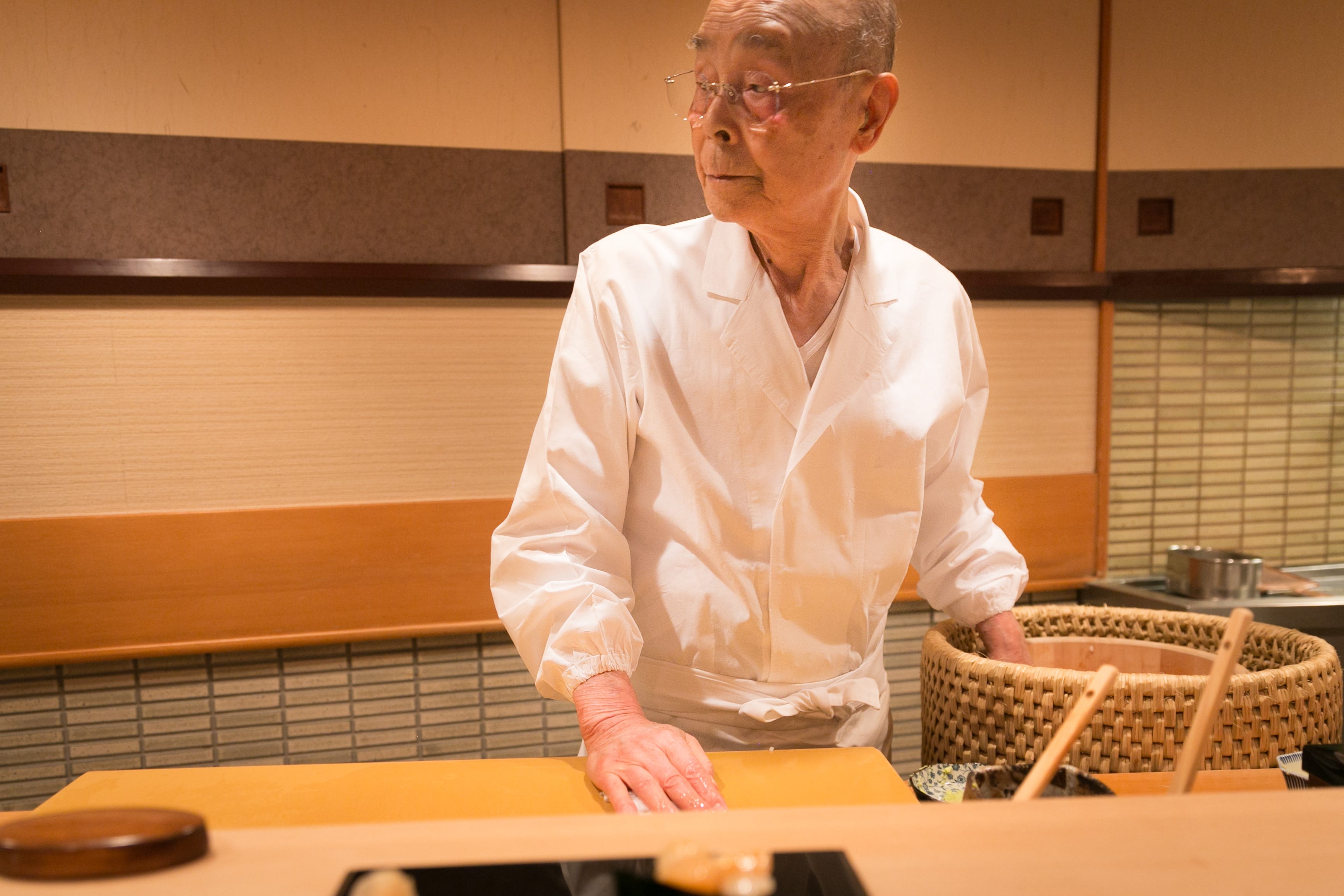
The example that came to mind on the return Shinkansen was the now 100-year-old Ono Jirō, the sushi master made internationally famous by the Netflix documentary “Jiro Dreams of Sushi”. He is now almost too famous to mention without sounding as though one has been bingeing on received cultural references, but he remains a useful example because he has become shorthand for obsessive craftsmanship.
I bring him up because, through some yummy quirk of fate, I somehow found myself in his restaurant some years ago. No, I was not paying, thank God! I still remember one of the other customers asking how he could make a single piece of tuna sushi taste so damned sublime. He replied, “Because I make each one honki de.” People often describe Jirō in terms of perfectionism, discipline, or obsession. I suspect honki might be better. He did not elevate sushi by chasing fame, novelty, or applause. He took his craft and gave himself to it so completely that it became the medium through which his life was expressed, one piece of sushi at a time.
Watching him work was not unlike watching some great budoka go about their business. There is no wasted movement, but also no visible strain. Nothing is decorative or done for effect. The rice, the fish, the timing, the pressure of the hand, the relation to the person seated across the counter: all of it has been refined through years of attention. What appears simple is in fact the result of a life from which many alternatives have been deliberately removed.
That is another side of honki that does not get mentioned much. To become serious about one thing is, inevitably, to become less serious about others. A path only becomes a path when other possibilities are set aside. In budo, people sometimes want the rewards of commitment without the narrowing it brings. We want progress without sacrifice, depth without too much inconvenience, and positive transformation without having to give up the very habits most in need of changing. Unfortunately, the Way has never been quite that accommodating.
This is why honki is more than effort. Effort can be temporary. It can be produced in bursts, especially when others are watching. It can also be fuelled by vanity, rivalry, insecurity, or the desire to be admired. Honki has a different quality. It is quieter and more durable, and is what remains when novelty has worn off and nobody is particularly impressed anymore. It is there on the wet Wednesday evening when the dojo is bloody cold, the body is tired, and the thought of staying home seems extremely sensible. It is there when one’s sensei points out the same fault for the hundredth time and you have to wake up to the unhappy possibility that the problem is indicative of your own inability to listen properly.
Budoka who leave the deepest impression are not always the ones with the most flamboyant technique or the most elaborate explanations. Often they are the ones who have become inseparable from their practice. Their kendo, judo, naginata, aikido, karate, or whatever the art may be, is not something switched on at the dojo door and switched off afterwards. It has shaped their timing, their posture, their manners, their patience, their silences, and even the way they occupy space. They do not need to announce that budo is a way of life. One can see that it has become so.
Of course, this can sound terribly lofty, and most of us spend a great deal of time falling short. I certainly do. But that is also why Karukome-sensei’s answer struck me as useful rather than merely inspiring. Honki is not a decorative ideal. It is a test. It asks whether we are actually doing the thing we say we are doing. If budo is supposed to polish the self, then where exactly is the polish? If training is supposed to cultivate character, then where is the evidence? If decades in the dojo have left us more arrogant, more brittle, more petty, or simply better at justifying our own faults in Japanese, then Sakamura’s poem offers a fairly direct diagnosis. Perhaps we have not yet become honki in the true sense of the word.
There is, however, something encouraging in this as well. Because honki is not the property of the gifted. It is not dependent on youth, athletic ability, social status, or even natural talent. Talent may make certain things easier at the beginning, but it can also become a rather efficient way of avoiding depth. The talented person is often praised too soon and challenged too late. Honki, by contrast, is available to anyone willing to stop bargaining with the path.
This, I think, is what links Karukome-sensei’s kendo, Sakamura’s poem, and Ono Jirō’s sushi. The field changes, but the principle does not. Whether one is holding a shinai, waving referee flags, shaping rice, writing books, teaching students, tending a garden, or simply trying to become a slightly less troublesome human being, there comes a point where half-measures reveal themselves for what they are. One either enters fully, or one remains at the edge commenting on the water.
Looking back, I think my initial pleasant surprise at Karukome-sensei’s answer says more about me than about her. I was probably expecting something grander, or at least something that sounded ‘more like budo’. But budo has never suffered from a shortage of grand words. It has shelves full of them. The more difficult matter is what to do on an ordinary day, in an ordinary dojo, with an ordinary body and an ordinary mind that would usually prefer comfort to correction.
Honki contains no mystery, which is exactly why it is so hard to escape. Are you serious, real? Not in the theatrical sense, or in the self-important sense. And certainly not in the sense of making a great performance of dedication. Are you truly seriously real, to the point that what you do begins to change who you are?
Sakamura’s poem suggests that when this happens, the world changes. I am not sure the world changes first. More likely, we do. And when we do, the world that had been there all along finally appears differently before us. That may be as good a definition of budo as any.
[1] Sakamura Shinmin (1909–2006) was a Japanese poet and calligrapher whose plain, accessible verse often focused on spiritual self-cultivation. The original poem reads: 「本気になると世界が変わってくる 自分が変わってくる 変わってこなかったらまだ本気になっていない証拠だ 本気な恋 本気な仕事 ああ人間一度こいつをつかまんことには」 Honki ni naru to sekai ga kawatte kuru / jibun ga kawatte kuru / kawatte konakattara mada honki ni natte inai shōko da / honki na koi / honki na shigoto / ā ningen ichido koitsu o tsukaman koto ni wa.



No comments yet.