






Budo Beat 74: Caught on Camera, Lost in Translation? Thoughts on the VRS Experiment
The “Budo Beat” Blog features a collection of short reflections, musings, and anecdotes on a wide range of budo topics by Professor Alex Bennett, a seasoned budo scholar and practitioner. Digestible and diverse discussions on all things budo, from the philosophy and history, to the practice and culture that shape the martial Way.
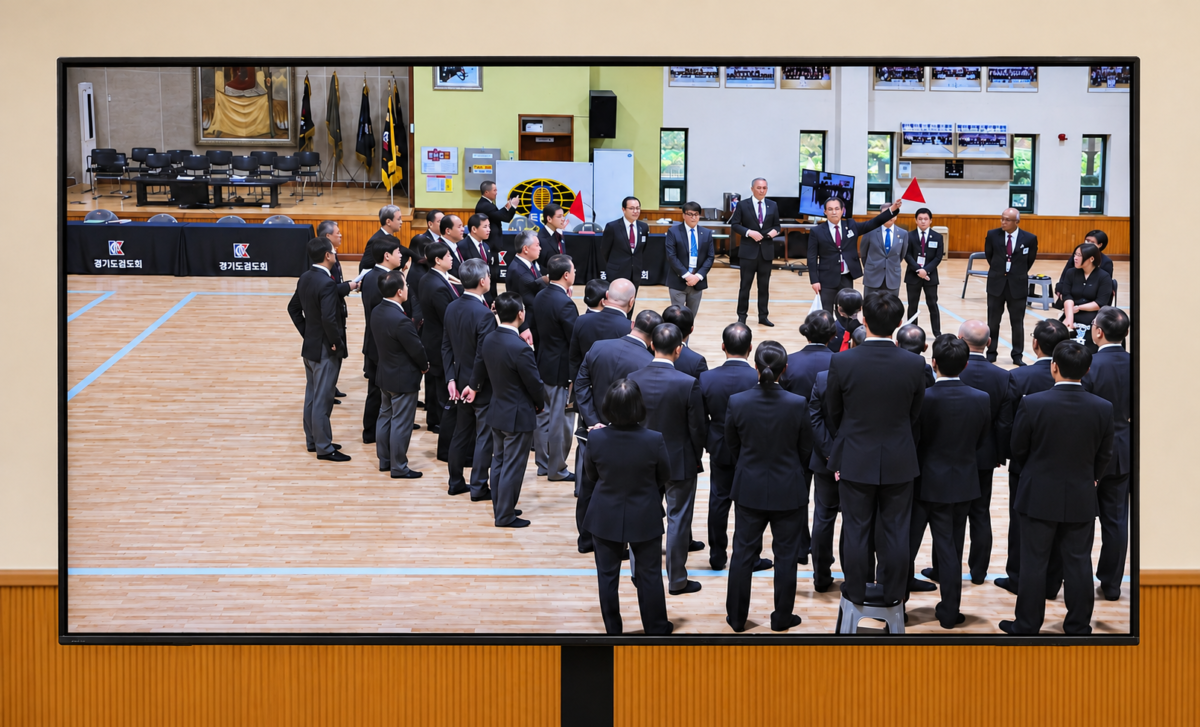
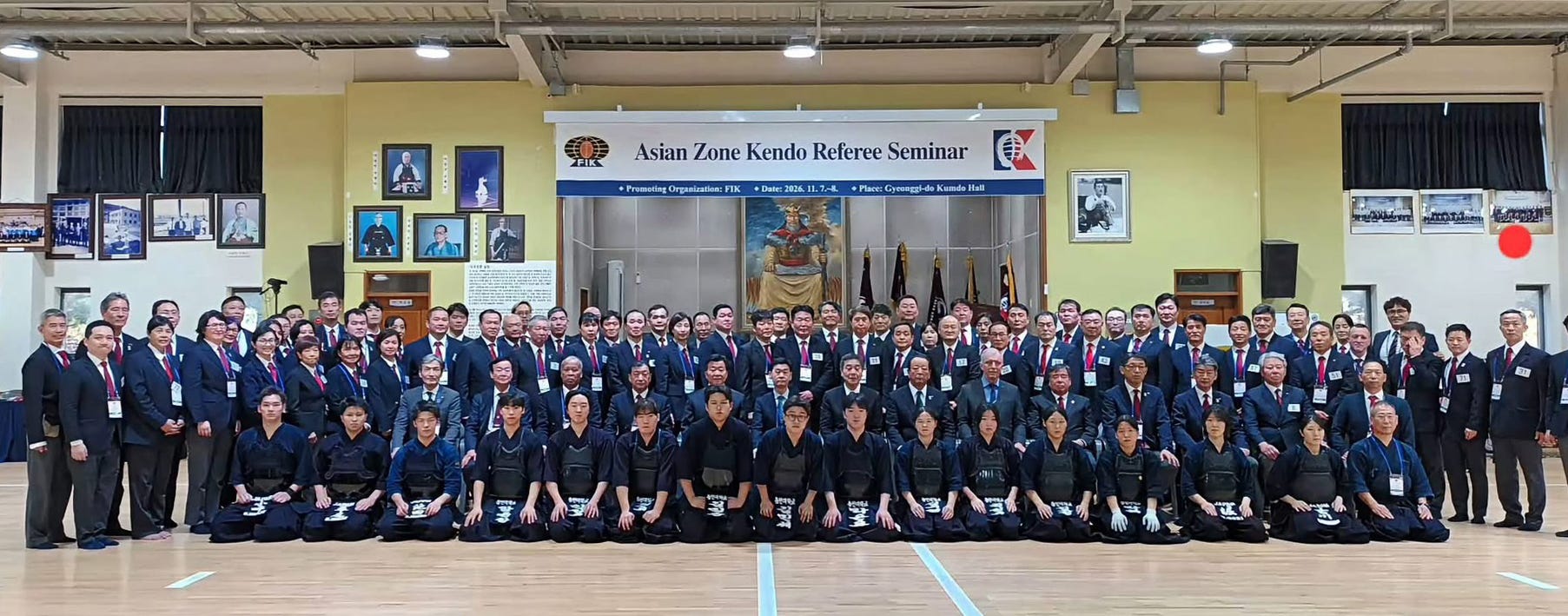
I was utterly bushed after two days at the Asia Zone Kendo Referee Seminar in Korea last weekend. The pressure was on. The seminar held in Siheung was part of the selection trial for referees to flutter their flags at next year’s World Kendo Championships in Tokyo. This seminar also served as a kind of trial for the “Video Review System” (VRS). We had three cameras set up strategically around our court for the educative purpose of dissecting contentious calls. I understand that the joys of VRS were also sampled at this year’s European and American zone seminars. It was also used for real at the recent annual Japan-Korea University Friendship Match, where decisions under review counted towards the match result.
You can see in the video below how it worked at that event. Red strikes men. The Shinpan award the point, but the white competitor signals to his coach that it was off to the side, and so a video check is then initiated. We can’t see the actual check process on this clip, but in the end the point is rescinded.
From the account I read of the university trial, the operators were able to pull up the relevant bits on a large screen without keeping the competitors waiting too long. All in all, the whole thing sounds like it was pretty smooth. Nevertheless, whether that makes it suitable for big regional or international tournaments is another question entirely. From the comments I managed to solicit from various people involved, the overall opinion is on the negative side of things.
Just last week, the All Japan Kendo Federation (AJKF) published its position online (here), based on various test runs of VRS. Its conclusion states, “At present, we have decided not to introduce a video review system.” No story, straight to bed? Well, not quite. The statement does acknowledge the technology’s worth, while also raising a number of concerns about how it might negatively affect the way kendo is contested.
I found plenty I concur with in the AJKF’s statement having spent two days getting along with VRS in Korea. I could see the value of having three video views to check contentious calls. A kote may look and sound like a palpable hit from where you’re standing. Yet, from another angle in the good old isosceles triangle formation, you might see the shinai catching the kote on the fist rather than the wrist. Or conversely, you’re positive that the cut fell short, but a view from the other side shows it clearly reaching the target area. The AJKF’s assessment certainly recognises this benefit of video review in situations like this.
The trials demonstrated that footage filmed from multiple directions could objectively and clearly establish such details as whether contact had been made with the target area. The time required to review footage was also relatively short, and the impact on the running of matches was found to be limited.
Anyone who has refereed knows how much depends on where you happen to be standing when a strike lands. That’s exactly why there are three Shinpan instead of one or two. VRS means the hitherto unthinkable option of replay in kendo, but is in no way a panacea for all debatable calls that inevitably occur in the heat of a match.
As all kendo people know, a yūkō-datotsu, or valid strike, asks an awful lot in terms of the criteria that must be met. The proper part of the shinai has to hit the target accurately with the cutting edge aligned correctly (hasuji). The strike must be executed with good posture and full spirit, and continued vigilance (zanshin) demonstrated after the fact. You can pick up some of that on a screen, but a lot of what constitutes a valid strike just can’t be reliably relayed in a video clip. In practice, the thing video replay helped us see at the seminar was where the shinai made contact on the target. The rest was not so simple.
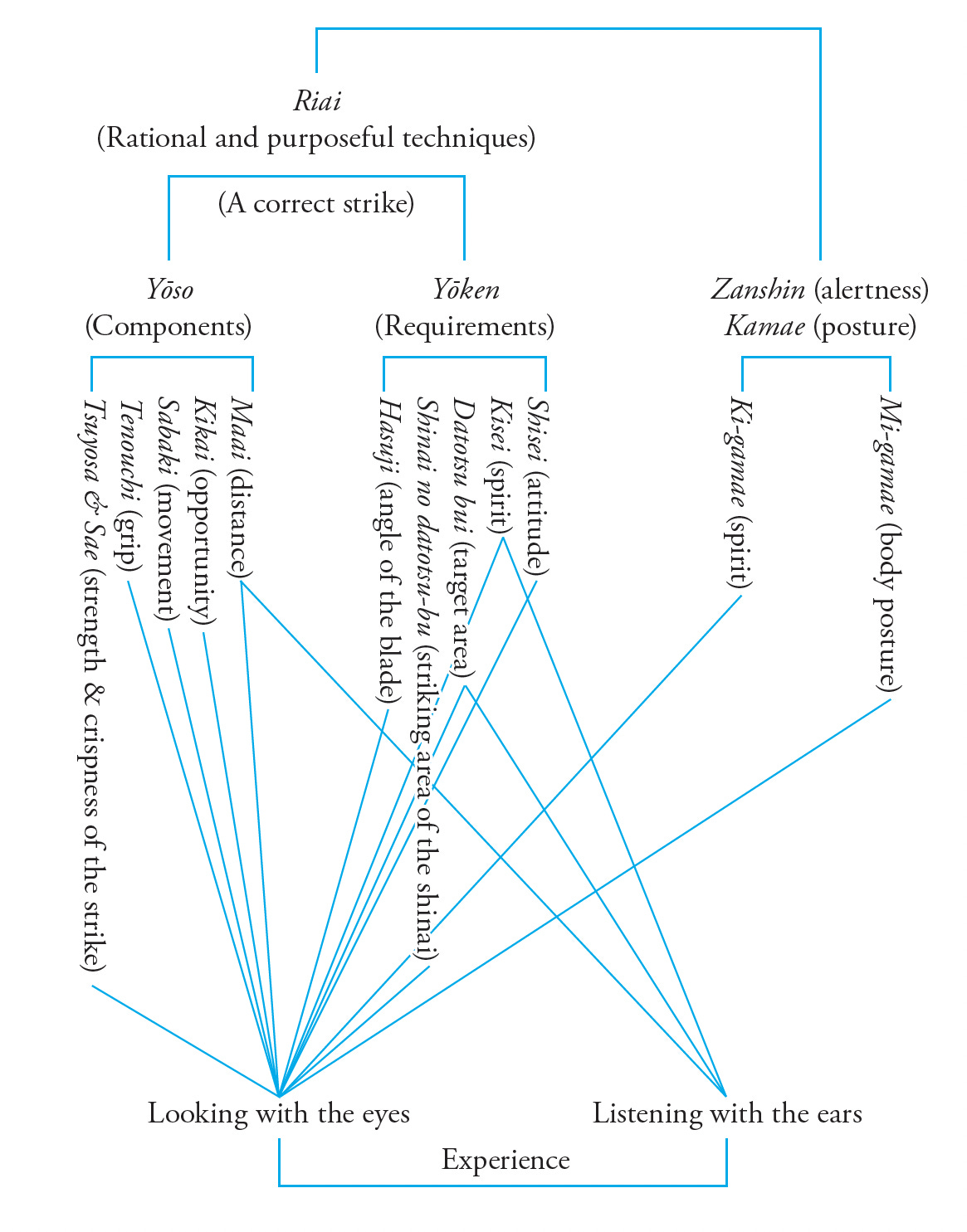
Please keep in mind that yūkō-datotsu depends not only on the things you can see, but also things you can hear, and some nebulous things you can sense only after years of training. It’s not a simple matter of whether or not a ball crosses a line. Sure, the camera records contact with 4K precision. But in many ways it’s kind of like how a microphone at a state dinner records the clink of glasses without establishing whether international relations have improved. There’s still a lot that just can’t be determined beyond a reasonable doubt with video, and sometimes even the shinai’s landing spot is nothing but a fuzzy blur.
The AJKF makes a similar point in its report.
A valid strike in kendo is judged through a comprehensive assessment encompassing not only the fact of the strike, but also spirit, sharpness, the action of the hands and zanshin, among other elements. It is difficult to assess all of these through video.
The slow motion clips we scrutinised at the seminar in Korea had no accompanying sound. When you’re on the court, you hear and even feel the contact in real time. Of course, a resounding whack can simply be a lucky strike devoid of that all-important intent, and a brilliantly deft technique (genmyō na waza) can be very light and quiet but still deserve the flags. Still, sound really helps determine validity. On the courtside screen, I found it nearly impossible to gauge the strength (kyōdo) of strikes when they connected with the target. Was the strike made with ki-ken-tai-itchi – unity of spirit, sword, and body? You know, that absolute foundation of kendo. More often than not, it was impossible to tell.
When we first gathered around that accusatory monitor, I guess we all thought visible, freezeframe evidence would settle any issue at hand, but this simply didn’t happen. For sure, a clear miss was easy enough to spot. With a clear hit, however, contact could be established but the other requirements of yūkō-datotsu were considerably less convincing. When, as was sometimes the case, the footage was inconclusive, we returned to the action scarcely better informed, or even more perplexed. At least science had been consulted, for whatever that is worth.
Promising things aside, I found that many at the seminar remained somewhat unconvinced that the VRS would be genuinely useful outside a Shinpan seminar. There was plenty to chat about when we all watched the footage together as a learning experience. Notwithstanding, once the conversation turned to the practicality of using it in real competition, the hurdles seemed harder to reconcile. The Japan-Korea university shindig offered a number of clues as to why this is the case.

I’m committed to keeping my work freely accessible to all budo enthusiasts, wherever they are. If you’ve enjoyed what you’ve found here and would like to support my ongoing efforts and projects, “buying me a coffee” (beer actually), or my books, would make a world of difference.
As per the video posted above, the coach could ask for a video review if the competitor signalled a given point was, in their opinion, not on the mark. And let’s face it, that signalling would be an exceedingly difficult impulse to override if you’re on the brink of glory, or inglory. If the option’s there, why not get the video officials to take a look? This possibility also features as a major downside in the AJKF’s official statement.
Introducing a system through which competitors or coaches could request a video review raises concerns that challenges to decisions would increase, potentially affecting trust in referees and the spirit of courtesy and respect that kendo has long valued.
As a competitor, you’ve got to learn to accept the calls and get on with the match, irrespective of whether you disagree with some of the ref decisions. It’s a small (sometimes big) act of restraint. It’s also a big part of how we show respect to the opponent, to the unfortunate souls assigned to make the decisions, and to the traditions of kendo. Not happy with a call? Life ain’t always fair so deal with it and just get on with the fight. If a glance at your coach becomes part of what you do after conceding a questionable point, you’ll eventually start doing it without thinking, even if just to try your luck. I think that’d change the feel and dynamic of kendo matches even if the reviews themselves were quick and some dodgy calls are rectified.
I reckon it would also change what people do in the dojo. The AJKF actually warns in its report that running matches on the assumption that video review is available could encourage “unnatural postures or approaches to competition aimed solely at avoiding being struck”.
For example, suppose a competitor finds that twisting slightly at the last instant is enough to send an attack off target, even if it leaves them in a hopeless position to respond. If they cotton on to the fact that such a shifty shift can save them a point on video review, they’ll have a reason to keep working on perfecting the move.
Whatever earns even a small advantage in the shiai-jō has a habit of turning up in practice. Of course, this also is a vital part of one’s training and evolution as a kenshi. Nobody goes into a match NOT wanting to win. I’ve been there, too. I was an avid competitor, always looking for small advantages to help me prevail in shiai. But where do we draw the line when it comes to winning matches at all costs? It’s a question that needs to be asked over and over because that line is constantly being prodded.
Then there’s the complicated logistical matter of making the system work across several courts. Is it possible to get equally useful angles on every court in play? What happens if the clearest camera is blocked, or the operator can’t find the exchange? What if somebody trips over the cord and pulls the plug out? So many questions…
The university trial did show what good equipment and capable operators could do now, so imagine what it’ll be like in five or ten years’ time. As it stands now though, the required infrastructure and manpower is a massive ask. The AJKF also identifies questions about operating procedures, which matters would be eligible for review, equipment placement, staffing and who would bear the cost. These are practical considerations that need answers.
I’d happily have three cameras at the next referee seminar. I thought it especially valuable as an educational tool when Shinpan from different countries and different levels were preparing to work together. With a video option available for autopsy, we can see where and why our judgements diverged. Spend a few minutes on some questionable call, listen to the instructor explain how they see it, and then go back out on the floor confident because you got it right, or with insights on what you need to be aware of to improve.
And this is right where the AJKF intends to put the technology to work.
Going forward, we will actively use video technology in referee seminars and training sessions to improve the quality of refereeing and achieve greater consistency in judging standards.
To be honest, I came back from Korea with mixed feelings. On the one hand, video review can help correct a bleedingly obvious error caused by a momentary lapse of concentration. On the other, I can also imagine new generations of competitors looking to their coaches after every ambiguous exchange in the hope of getting from the two-dimensional monitor what they failed to get from the three-dimensional referees. Yes, correcting a bad call offers an immediate benefit. But encouraging future generations of kenshi to treat every decision as a possible negotiation is asking for trouble.
Call me old school, or just old, but now I prefer to spend my hours in the dojo honing my ability to strike with intent and honesty, and deal with whoever stands before me with integrity. If I get munted in the process, then so be it! Another one in the bank that’ll make me stronger tomorrow. I don’t compete anywhere near as much as I did in my younger years, but when I do, I know that bad calls go my way as well as against me. No, it’s not ideal, but shit happens.
Kendo’s humanity is part of what makes it a Way. In essence, two people testing one another, and three others accepting responsibility for judging the encounter to the best of their human ability. And as humans, the refs are fallible, which is why they must keep learning through experience. Imperfection alone seems to me to be an entirely insufficient reason to transfer their authority to technology. Sure, technology can help us see what we missed, but we need to retain responsibility for deciding what it means. Anyway, the robots will have plenty to occupy them from now on. I’d like to have at least one place in which they have to take off their shoes and take a back seat to human imperfection.




No comments yet.