


Budo Beat 73: Shot of the Day – A Perfect Moment in Time?
The “Budo Beat” Blog features a collection of short reflections, musings, and anecdotes on a wide range of budo topics by Professor Alex Bennett, a seasoned budo scholar and practitioner. I compose digestible and diverse discussions on all things budo, from the philosophy and history, to the practice and culture that shape the martial Way.
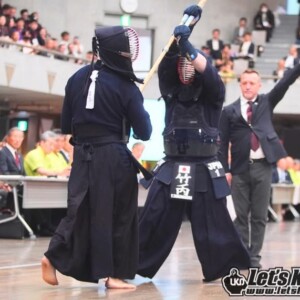
Most of the photographs I took at the All-Japans last Tuesday (Nov. 3) were not so brilliant. By the time the final came around I had a comprehensive record of what happens after something decisive has happened. But then, on the last strike of the last match, I managed to get the last word. THE photo of the day.
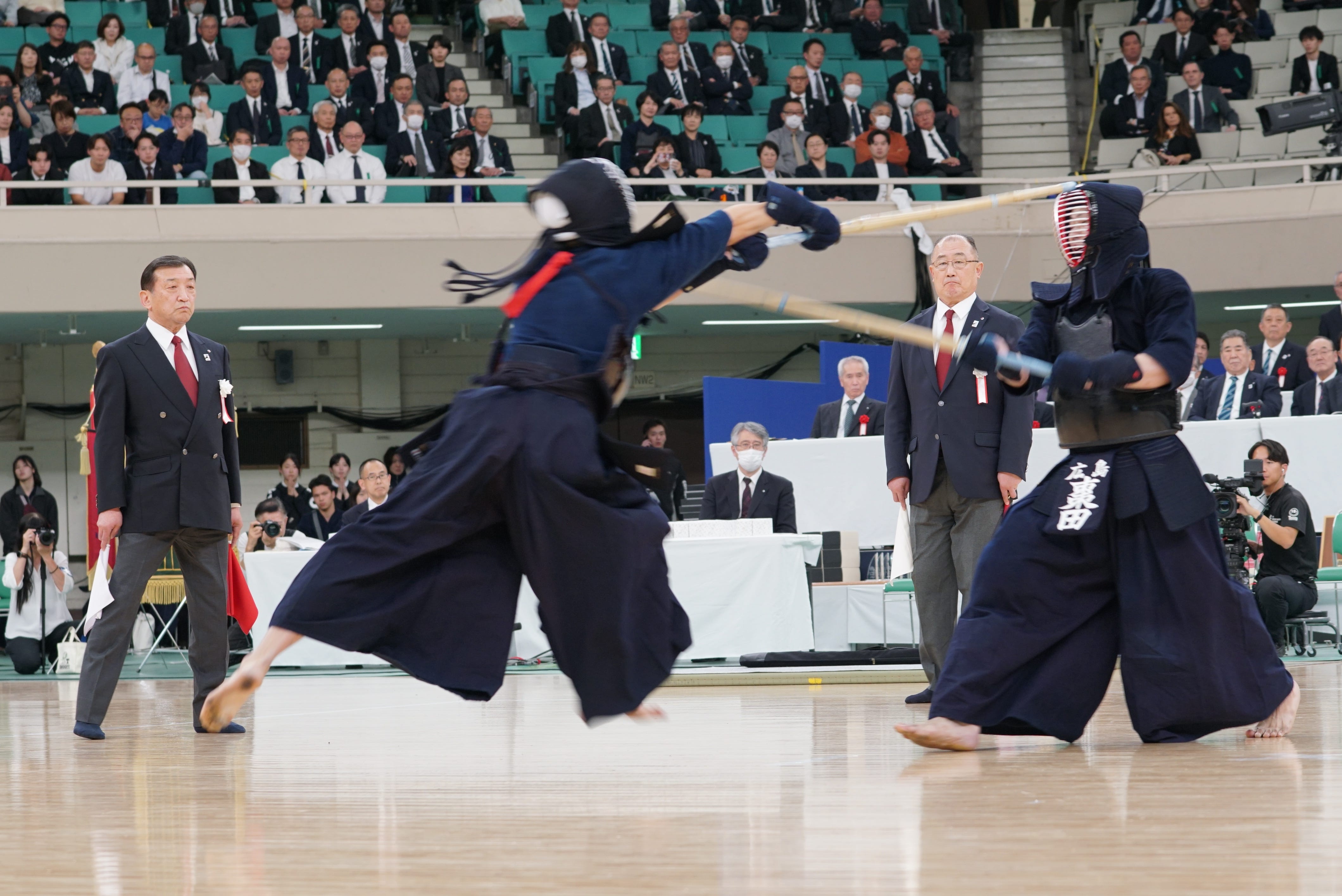
The man in the air is Nakada Ryūnosuke (Tokyo) in his All-Japan debut. On the receiving end is Natsumeda Ryūsuke (Hiroshima), the formidable 2023 champ. Nakada had already taken a point against him with men, and then he took the title with this total beauty of a strike. Am I just saying this because I finally got the photo timing perfectly right? Or, was the strike itself perfectly right?
At first, I thought rather conceitedly that was more the former. It was on the Shinkansen back home to Kyoto that I really had a good look at it. The red ribbon and the cords of Nakada’s men were fluttering behind him. His arms were extended fully, allowing his shinai to traverse the vortex and reach Natsumeda’s head. Both his feet were clear off the floor as if he were flying. Across the middle of the picture is the fuzzy blur of Natsumeda’s shinai as if it was about to do something, but was well and truly nipped in the bud. In the time it took me to look from one end of that blur to the other, the whole men strike could have happened several times over.
Taking photos of kendo matches is usually a frustrating affair. I can hardly remember what it was like back in the expensive old days of film. Nowadays, I could video the day’s matches in 4K and simply pick out the best frames. But where’s the fun in that? Sure, it would save me a good deal of cursing about the dozens that I missed because I blinked. But, I genuinely enjoy trying to read matches through the viewfinder. It’s a challenge, and a nice little test of my own kendo.
One competitor takes half a step, the other’s shinai tip shifts a smidgen, and whammo! Somebody’s gone. You can feel it about to happen. And if you manage to get a spot on shutter shot, it’s almost like executing a successful counter-technique. If I push the button when I see the hit, that means I’m way off the mark. The camera never lies. That’s what makes courtside photography such brilliant mitori-geiko, practice by watching. I’m always looking for little indications of what’s about to transpire next. It’s the practice I’m having when I’m not having practice.
Anyway, on the train back, I was able to relax and give my full attention to what had happened. Can in hand, I opened my Mac and drifted into this awesome image I had managed to capture. There was so much movement and energy in the frame, yet it was perfectly still. Many things came to mind as I immersed myself in the scene. The first thing was sutemi, literally “to discard the body”. That is, to completely sacrifice yourself into the attack.

I’m committed to keeping my work freely accessible to all budo enthusiasts, wherever they are. If you’ve enjoyed what you’ve found here and would like to support my ongoing efforts and projects, “buying me a coffee” (beer actually), or my books, would make a world of difference.
It was a perfect pictorial representation of this crucial budo concept. Once you go, you go. It’s all or nothing. Nakada really does look like a little comet hurtling through the cosmos, about to smash into some unfortunate celestial body. To launch yourself at your opponent with such commitment and resolve takes serious courage. This is precisely the mindset we aspire to with each repetition of the basics we do in the dojo. But with this speed? This amount of power? This unwavering belief? It is truly phenomenal. And so, once again the camera ain’t lying.
But the longer I looked at the photo, the lighter my beer can got. Somewhere along the way between Tokyo and Kyoto, another famous old kendo teaching came to mind.
Know what goes into a strike with the sword.
First, technique (waza). Second, arms (ude). Third, spirit (kiai).
Fourth, gut (hara). Fifth, discipline of the mind.[1]
Waza is technique. It means having the correct form, right distance, and the apposite timing to strike at an opportunity, rather than letting rip with a Hail Mary and hoping for the best. Ude, the arms, is the physical delivery of the technique. In other words, the shoulders and arms free of any superfluous tension, and the grip closing just at the moment of contact (tenouchi), so that the technique arrives just at the point of the target and is not wasted on the way there. Kiai is the spirit or energy that drives the strike and is a declaration that you bloody well mean it. Hara, the belly or gut, is actually about composure rather than that thing hanging out over your belt. It’s a settled centre that keeps calm when in danger, and gives you the nerve to commit to your strike wholeheartedly with sutemi.
Kokoro no hō is the principle of the disciplined mind. I reckon this is the hardest thing to pin down. My understanding is it’s a mind that’s clear and uncluttered. It’s the unperturbed mind that essentially governs the other four elements. The numbering here is not a ranking as such. It is a progression of one’s study. It starts with what can be actually seen and corrected by a sensei. Then it moves on to what needs to be cultivated through years of hard training which can only be inferred. An attack missing any one of these five elements cannot be considered a perfect strike. Furthermore, the visible parts only come together when the invisible ones are properly in place.
Looking at the photo, I was struck (pun intended) by how hard it was to separate any of those elements. “This is it,” I thought. “It’s pretty close to the perfect goddam strike.” Yes, I know there are some testy types out there who would gleefully point out that the shinai appears to be only touching the men-gane (the metal grille on the men). So how can it be perfect?
It just is, okay? Look at the rest of the pic. Natsumeda’s shinai is already moving. Nakada’s arms have extended, his whole body is going forward with unstoppable momentum, and his shinai has arrived. His intent, his spirit and the force of his body all arrived in one cut in a consolidated ball of fire. If you were there, you had no doubt it was ippon. And, the photo shows me why. By the time the shutter opened, both his feet were off the floor. Whatever chance he’d had to hang back and see what Natsumeda was going to do, he’d given it up. Nakada had an opening, and he put every ounce of his being into the strike. There’s a particular pleasure in seeing such a technique come off this cleanly in the final, against somebody Natsumeda’s calibre, who could do nothing to stop it.
For some reason, the detail I still keep coming back to in the photo is Nakada’s left foot. It’s a long way back, with the slightly blackened sole turned towards the camera and plenty of daylight under it. There’s no way I could’ve told you a thing about that foot when the flags went up. By then it was back on the floor, and I was looking at the new champion. In the photograph, the flags are still down, the shinai is right on the mark, and the foot hasn’t come down yet. It never will.
[1] うつ太刀は一技二腕三気合四腹五心の法とこそ知れ (Utsu tachi wa ichi waza, ni ude, san kiai,shi hara, go kokoro no hō to koso shire)



No comments yet.